This project originally began as a virtual exhibit which can still be found here, The National Guard Company at the Fort. This was one of the three virtual exhibits I assembled in 2023 when I was doing an internship at the Old Stone Fort while getting my Masters Degree in History at SUNY Albany. Out of those three exhibits I found that this topic was written about the least. As a Site Interpreter (now Museum Experience Manager), I try to mention to our guests that from 1857-1873 this building was an armory that was used as the headquarters for a National Guard Company from 1865-1868. Yet there was much more to the story than that. This article is filled with a combination of primary sources and secondary sources for the purpose of telling the whole story. A version of this article appears in the “Spring-Summer 2025 Schoharie County Historical Review.” I hope you enjoy.
~ Clay Edmunds
The Old Stone Fort has been a staple of Schoharie County for well over 200 years mainly for its tenure as the Lower Fort in the Schoharie Valley during the American Revolution. Originally built as a High Dutch Reformed Church in 1772, it was one of the three buildings fortified just five years later. The Lower Fort notably kept people safe during the 1780 burning of the valley raid while simultaneously being an active church. This church remained active until 1844 when the congregation split in half and moved to two newer buildings. Although still a church, regular religious services between 1844 and 1857 were no longer being practiced in said building. This Old Stone Fort officially ceased being a church on April 10, 1857 when it was purchased by New York State to be converted into an armory.
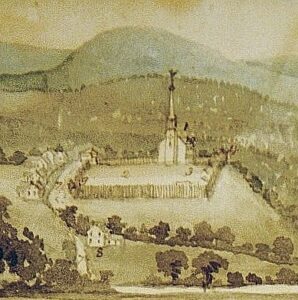
With the exception of Jeff O’Connor’s The Old Stone Fort: Guardian of Schoharie County History Since 1772, most stories about this building in recent times have not gone into depth regarding its time as an armory. This article focuses on both the process it took for the church to become an armory and it’s tenure as an armory with the National Guard Company for whom this place was their head quarters. Before proceeding it should be noted that several documents and newspapers referred to this building as an arsenal or armory interchangeably. The official name of the Old Stone Fort during this time was the State Arsenal at Schoharie, despite the fact that weapons were not manufactured in said building as is the case with most arsenals.(1) This building will be referred to as an “armory “in this article even though the term “arsenal” was also accurate.
Turning the Church into an Armory
As noted by Arthur B. Gregg in the July 1942 issue of the Schoharie County Historical Review, efforts were made as early as 1849 to convert this church into a state arsenal, yet Governor Hamilton Fish was unable to secure a purchase.(2) During this time New York State did not take precedence in preserving historic buildings for the sake of preserving their history. Otherwise the Middle and Upper Forts would probably still stand today. Instead, many buildings had to be in use in order to receive state funding to be preserved. During the 80th NY Congress, which took place in 1857, the Assemblymen from Schoharie County, Democrats William Crowe and Tobias Bouck as well as the Assemblyman from Delaware County, Republican Barna R. Johnson argued that this church should be turned into an armory.(3) NY State Senator Joseph H. Ramsey was also said to have helped get this building preserved as noted in an 1896 issue of the Albany Argus.(4) There was existing legislation on appropriating $400,000 to be be used for building an arsenal in New York City. While that bill was still in committee, Assemblyman Crowe put forward a motion to appropriate $5,000 for the purpose of preserving the Old Stone Fort and to transform it into an armory. Assemblyman Bouck concurred, noting that the church could be transformed at a reasonable price.(5)
Assemblyman Johnson went even further in his support by giving an impassioned speech on the floor. In his speech he asserted that the State of New York has spent millions of dollars to build the Erie Canal which spanned three hundred and sixty miles in length from Albany to Buffalo. He described the canal as being “…more valuable to the inhabitants of the counties through which it passes than a river of gold.” He also emphasized that the State has spent millions of dollars on “charitable and literary institutions…and for the express benefit of certain localities.” But then asked the rhetorical question as to whether the State “…has ever appropriated a single dollar to benefit Schoharie and Delaware [counties].”(6)
He further noted that the existing bill provided for the funding and construction of arsenals in Albany, Troy, Schenectady, Rome, Utica, Syracuse, Rochester and Buffalo. He implied that since these places have received so much assistance “they almost think they have a legal right to demand anything.” Regardless, he further made the point that because this church was used as a fort during the Revolutionary War, it would make a great arsenal. He expressed the need to preserve its history as the church had seldomly been used since two newer Reformed Churches were built in the villages of Schoharie and Gallupville around 1844.(7)
The primary reason given for preserving the Old Stone Fort was that it survived the burning of the Schoharie valley during the Revolutionary War in 1780. On October 17, 1780 forces led by British Colonel John Johnson and the Mohawk Captain in the British Army, Joseph Brandt burned the Schoharie valley to the ground. At around 4pm as they were leaving the valley a force of loyalists fired upon the Old Stone Fort with a 3 pounder grasshopper cannon. The Americans exchanged fire for a bit and the building was hit by at least two cannon balls. There is a cannon ball hole that is just below the roof which has been left as a mark from this attack ever since.
The arguments for preserving local history and for building another armory succeeded as a law was passed which allowed for $3,000 to be set aside for the Old Stone Fort. The consistory (local administration who owned this church) were about $700 in debt. Reverand R. Wells, Peter Mix, and C. H. Van Dyck were appointed to the commission to sell this building to the state.(8) The State purchased this church for $800 and then spent another $1,000 on renovations. Construction was delayed as there were some complications with it’s funding. In September 1859 the Schoharie Republican noted that funding was not given to the Old Stone Fort despite the fact that it’s funding was added to the bill which appropriated the funds to build multiple arsenals within the state. It was due to a “technicality in the law in question.” When the $275,000 was appropriated for the bill as a whole, it was done before Schoharie was placed on the approval list. The law in question only allowed for purchasing the old church.(9)
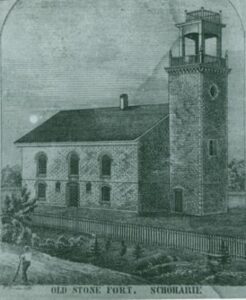
This discrepancy was likely resolved by March 1860 when the Schoharie Republican noted that work on the Old Stone Fort would begin once the weather was decent. The $1,000 needed to be provided to renovate this building was mainly secured by Assemblyman Barna R. Johnson.(10)
Renovations
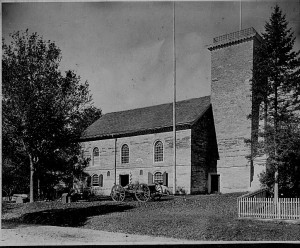
The belfry was removed and the tower was raised. In addition, a second floor was added and concrete was poured over the first floor. An article from the Spring 1962 issue of the Schoharie County Historical Review noted that New York did not do much with the old church until 1865.(11) Jeff O’Connor’s book seems to clarify that it was likely that the church needed to be repaired before it could be renovated into an armory.(12)
An article from the Schoharie Union from April 19, 1866 noted that this armory in Schoharie contained two brass guns, 600 muskets, 6,000 ball cartridges and 8,000 percussion caps. The Middleburgh Armory (which was a barn) was sold and the accoutrements in it were transferred from there to this new Schoharie Armory. After all repairs and renovations were made, this building became the regimental armory for the 108th NY National Guard in 1865.(13) More specifically it became the headquarters for Company B.
The National Guard Regiment
This National Guard Company was formed during the end of the Civil War and was never mustered out. It was originally part of the 40th NY Militia Regiment in 1861. At that time, their headquarters was in Middleburgh. Colonel Elias A. Brown was the Commander of this Militia regiment. The 40th regiment consisted of five companies. Company A was from Broome and Conesville. Company B was from Blenheim, Gilboa and Jefferson. Company C was from Cobleskill and Richmondville. Company D was from Middleburgh and Fulton. Finally, Company F (there was no Company E) was from Esperance & Carlisle. These companies were ordered to elect their own officers with the exception of Companies C and D which had already done so.(14)
It was not until December 1864 when they were transferred into the 108th NY Infantry Militia Regiment.(15) Most of these men enlisted on January 14, 1865, a few enlisted later. Regardless, this Regiment was dissolved on August 14, 1868. Colonel Brown briefly commanded them before being promoted to Brigadier General.
Colonels in Command
The 108th was then Commanded by Colonel Almon N. Wakefield until September 1866. Wakefield was described by the Albany NY Morning Express as being “universally disliked, and by many despised, on account of his meanness.” This newspaper stated that he “quarreled with several of his officers” and caused them to be arrested. He was subsequently court-martialed in 1866 and charged on 10 accounts which included misusing funds and unlawful imprisonment. Elias A. Brown (now a Brigadier General) presided over the court-martial trial and Wakefield was ultimately found guilty on 9 out of the 10 charges. He was fined $100, cashiered (dismissed from the military) and disqualified from holding any office within the New York State Militia.(16) He was subsequently replaced by Colonel Alonzo Ferguson who commanded the 152nd NY Infantry during the Civil War.(17)
First General Order
The first General order for the 108th was printed on March 6, 1865. It made several references to the Militia Law of the State of New York book and called for a meeting to be held between the Commissioned (Colonel, Lieutenant Colonel, Major, Captains & Lieutenants) and the Non-Commissioned Officers (Sergeants and Corporals) on March 21, 1865. Officers were at that point only required to appear wearing their fatigue caps. At this point there were nine companies each consisting of 100 men. Eight of the nine companies already held their officer elections.(18) At this time, most military orders were printed and many of them were submitted in newspapers (this was how some of the men were notified to appear for service).
Incident in Jefferson
Up until the summer of 1865, Richard Wallace served as the Captain of Company B. He resigned after an incident in Jefferson, NY when his company performed a cannon salute on the 4th of July and accidentally shot off the hand of Dr. Tunis Cooper as he came within range of the cannon. A relative of Dr. Cooper asserted that the reason he came within the cannon’s range was to protect a few children who came within range of the cannon while playing.(19) An election was subsequently held after the Captain’s resignation to fill the vacancy on July 29, 1865 at the Schoharie Agricultural Hall.(20) Sergeant Charles M. Throop won this election and became Captain, serving for the remainder of this Regiment’s existence.
Illegal Boxing Match in Esperance
Later that same year in November became the only time that the 108th were dispatched. There was an illegal boxing match in Esperance that was about to occur. The match was said to be a “world’s champion prize fight” and it consisted of James Elliot of New York City and Bill Davis of California. A resolution from a meeting in Cobleskill called for Colonel Wakefield to assemble Company B to travel to Esperance by train to help Sheriff Ferris keep the peace from an anticipated angry crowd as the fight was cancelled. The Company took the train to Esperance around the middle of a very cold and rainy night. As it turned out the trip to Esperance proved unneeded as the anticipated angry crowd never arrived. President Ramsey of the Albany & Susquehanna Railroad prevented said crowd from boarding the train to Esperance. Nevertheless, Company B remained on guard until the morning.(21)
After the National Guard Regiment Disbanded
The fort remained an armory for five years after the National Guard Company was disbanded in 1868. The 100th anniversary of the Old Stone Fort was held at the Fort in 1872 during the 4th of July. In addition, a festival was held on July 25th of that same year at the fort to raise funds to purchase a library for a Sunday school. The Schoharie Union newspaper noted that “supper, ice-cream, raspberries, pine apple and so forth will be served up.” A total of $90 was gained through this fundraiser. (22) In addition, funds were being raised at that time to build a headstone for Colonel Simon H. Mix of the 3rd NY Cavalry who was killed while leading his brigade on June 15, 1864 during the Siege of Petersburg.(23)
The Fort goes to the County and becomes a Museum
New York State no longer needed to use this building as an armory in 1873 so they donated it to the county to preserve on June 11 of that same year through an act of legislation. According to an 1896 article from the Albany Argus, the State would reclaim this building if it was not kept in repair.(24) In 1876, during the Centennial of the United States, around 10,000 people visited the Old Stone Fort to witness a monument to David Williams and his wife Nancy Benedict Williams be erected. David Williams was one of three Militia Men (John Paulding and Isaac Van Wart were the others) who captured British Major John Andre which led to the discovery of General Benedict Arnold betraying the United States. The Schoharie Historical Society formed in 1888 and this building officially opened as a museum in 1889. (25)
The effects of the Old Stone Fort becoming an armory are still seen today. Most notably the concrete floors which held canons now hold exhibits. The second floor and staircase which were probably added in the 1860s now hold many other exhibits which are set up in a manner to replicate a 19th century museum. Instead of being a way to access the second floor, the now raised tower is used for additional storage. In conclusion, this article was intended to emphasize the most drastic transformation of the Old Stone Fort, it’s conversion from a church to an armory.
References
1. Jeff O’Connor, The Old Stone Fort: Guardian of Schoharie County Since 1772. pgs. 65-74.
2. Arthur B. Gregg, “Old Stone Fort Militia of 1865.” The Quarterly Bulletin Published by the Schoharie County Historical Society. July 1942. p. 8-9.
3. Democratic Republican, Schoharie NY, April 9, 1857. fultonhistory.com.
4. Albany Argus, Albany, NY. 1896. fultonhistory.com.
5. Democratic Republican, Schoharie NY, April 9, 1857. fultonhistory.com.
6. Ibid.
7. Ibid.
8. Schoharie County Historical Review, Spring-Summer 1962. Pg 24.
9. Schoharie NY Republican, September 8, 1859. fultonhistory.com.
10. Schoharie NY Republican, March 8, 1860.
11. Schoharie County Historical Review, Spring-Summer 1962. Pg 24.
12. Jeff O’Connor, pg 66.
13. Schoharie NY Union, April 19, 1866. fultonhistory.com.
14. Schoharie NY Republican, May 2, 1861. fultonhistory.com
15. State of New York Adjutant General’s Office, Albany NY, July 8, 1867.
16. Schoharie Union, Schoharie NY, July 20, 1865. fultonhistory.com.
17. Albany Morning Express, Albany NY. 1866. fultonhistory.com.
18. General Order No. 1. March 6, 1865.
19. “Dr. Tunis Cooper of Jefferson, N.Y.” by Tunis Goodenough, Obtained from the Town of Jefferson Historical Society of Schoharie County.
20. Notice for Company Election, Dated at July 4, 1865 to be held on July 29, 1865.
21. Arthur B. Gregg, The Quarterly Bulletin July 1942, pgs 8-9. This event was reported by the November 23, 1865 issue of the Schoharie Republican. This original source was provided by Ken Jones.
22. Schoharie NY Union, June 28, 1872. fultonhistory.com.
23. Schoharie NY Union, August 2, 1872. fultonhistory.com.
24. Albany Argus, 1896. fultonhistory.com.
25. Albany NY Morning Express, Albany NY September 18, 1876. fultonhistory.com
Bibliography
Albany Argus, Albany, NY. 1896. fultonhistory.com.
Albany Morning Express, Albany NY. 1866. fultonhistory.com.
Democratic Republican, Schoharie NY, April 2, 1857 & April 9, 1857. fultonhistory.com. These newspapers were photographed and sent to Tom Tryniski of fultonhistory.com by Clay Edmunds.
Goodenough, Tunis. “Dr. Tunis Cooper of Jefferson, N.Y.” Obtained from the Town of Jefferson Historical Society of Schoharie County. This specific article was provided by Kevin Berner and Stephanie Ruquet.
Gregg, Arthur B. “Old Stone Fort Militia of 1865.” The Quarterly Bulletin Published by the Schoharie County Historical Society. July 1942. p. 8-9.
Head-Quarters 108th Regiment N.G.S.N.Y., General Order No. 1. Schoharie NY, March 6, 1865. By order of Col. A.N. Wakefield, J. Maternaghan, Adjutant. Obtained from the Old Stone Fort Museum Archives.
Notice for Company Election, Dated at July 4, 1865 to be held on July 29, 1865. Obtained from the Old Stone Fort Museum Archives.
O’Connor, Jeff. The Old Stone Fort: Guardian of Schoharie County Since 1772. pgs. 65-74.
Schoharie County Historical Review, Spring-Summer 1962. Pg 24.
Schoharie Republican, Schoharie NY, April 21, 1859; September 8, 1859, March 8, 1860 & May 2, 1861. fultonhistory.com. These newspapers were photographed and sent to Tom Tryniski of fultonhistory.com by Clay Edmunds. A section of the Schoharie Republican, November 23, 1865 issue was provided by the Esperance Town Historian Ken Jones.
Schoharie Union, Schoharie NY, July 20, 1865, June 28, 1872 & August 2, 1872. fultonhistory.com.
State of New York Adjutant General’s Office, Albany NY, July 8, 1867. Obtained from the Old Stone Fort Museum Archives.
Vroman, Myron. “Chronological History of the Old Stone Fort.” The Quarterly Bulletin Published by the Schoharie County Historical Society. July 1942. p. 11.
All pictures were obtained from our website from “The Old Stone Fort” link under “About Us.”