This exhibit showcases various appliances which could be found in a kitchen. Some of these appliances are still in use today while others have been replaced by more effective tools.
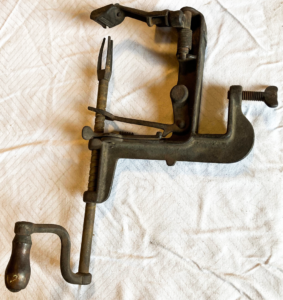
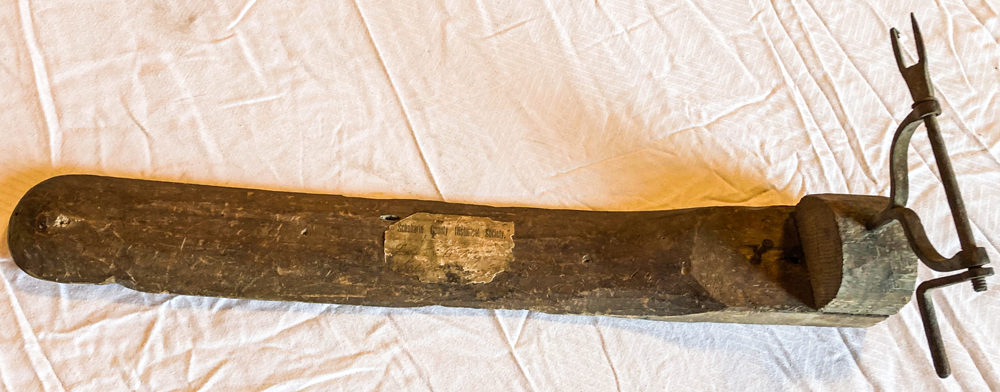
The picture to the top left is an apple core remover. This device was used to peel, slice and remove the core from apples before they were eaten or cooked. This was commonly done when making pies. To use, you stick the prongs in the stem side of the apple and then crank the lever. When the apple has been peeled and sliced, the core remains separately on the prongs.
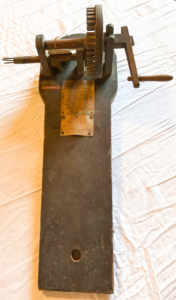
The picture next to it is of an apple parer, which was used to peel the skin off from apples. The card on this device noted that it was probably constructed in 1837.
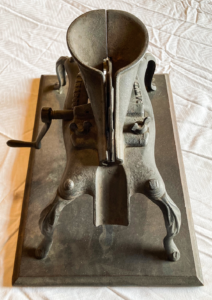
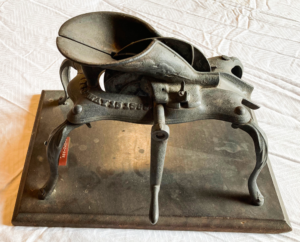
The two pictures to the top right showcase the same cast iron cherry pitter (a cherry pit remover), one picture displays the front while the other displays the side. This particular cherry pitter has a patent from May 15, 1866.
The bottom picture is of another apple parer.
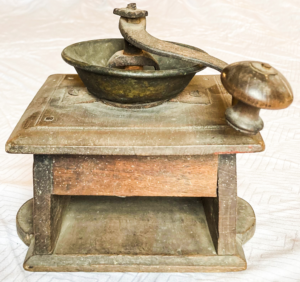
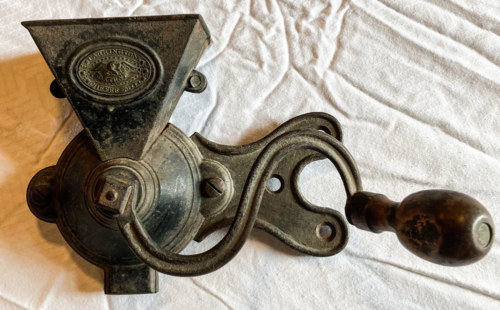
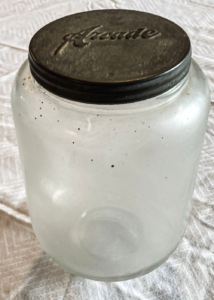
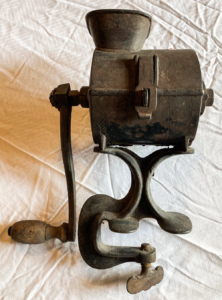
A coffee mill, grinder and jar are shown in the top pictures. The coffee grinder on top was manufactured by Carrington Coffee Mills. James Carrington of Connecticut came out with the patent for his Coffee Mill company on April 3, 1829. Coffee grinders were often put on top of jars like the one displayed above. This particular jar was manufactured by Arcade who also manufactured coffee grinders. The bottom picture shows another coffee grinder.
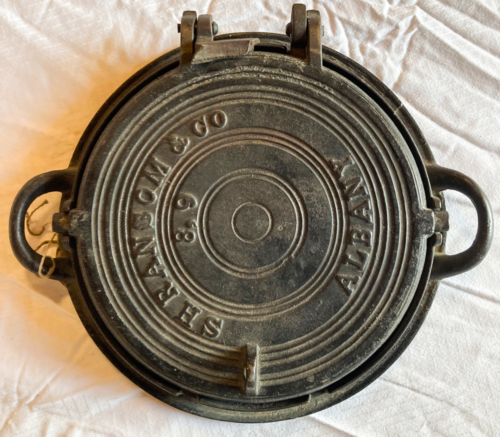
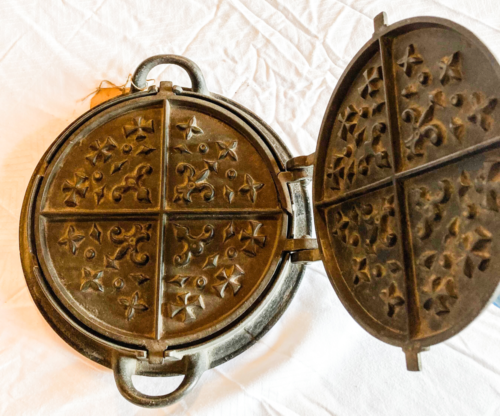
These two pictures showcase the same Waffle Iron. The left picture shows it closed while the right picture shows it open. This particular Waffle Iron was patented on August 24, 1869. It was invented by Cornelius Swartwout and manufactured by S.H. Ransom & Co in Albany, NY. It was owned and used by the Morehouse family and donated to the museum by Julia Morehouse.
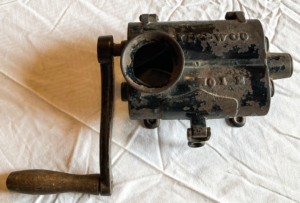
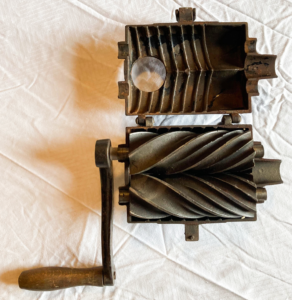


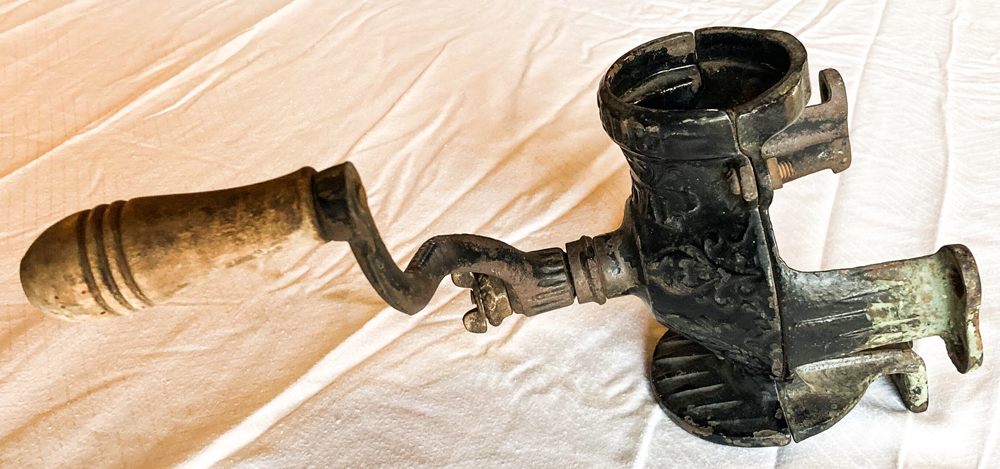
Ever wonder how sausage is made? These above pictures showcage appliances used to make sausage. The top left picture shows a sausage grinder (although grinders such as these can be used to ground other types of meat). The center and top right pictures are of a sausage stuffer that also works as a grinder. One picture depicts it closed while the other one shows it open. The two bottom pictures are tin tube sausage stuffers with wooden pressers. The wooden presser is roughly the same size as the tin tube as it is placed inside of the tube to push out the ground meat that will become sausage.


The above pictures showcase an apple peeler and a corn husking tool. The two pictures on the bottom are of a lemon squeezer. This cast iron Apple Peeler (also referred to as an Apple Parer) was designed by Frederick B. Rising and it was patented on May 24, 1898. It is a Turntable ’98 model that was manufactured by Goodell Co. from Antrim, New Hampshire. When being used to peel apples it would be held vertically with the two spur gears (wheels) facing upward. When the hand gear to the side is turned, the spur gears will move causing the fork which peels the apple to move. Information on the Apple Parer was obtained from;
Viney M. (2007). The Virtual Apple Parer Museum, http://appleparermuseum.com.
The metal blade of this corn husking tool (also called a corn husking peg) was used to remove the leafy outer material of the corn. Lemon Squeezers such as the one displayed below were commonly used for making lemonade and citrus salad dressings and desserts.


The picture to the left showcases an egg boiler while the picture to the right is of a muffin iron.


The picture to the far left is of a wooden potato masher. Next to that picture is one of a meat maul. Two wooden handle metal blade food choppers are next to the meat maul. These next three pictures are of mortars and pestles. Next to the final mortar are two cheese graters and an old hatchet. Like the meat maul, the hatchet was used for smashing meat. The bottom picture showcases a nutmeg grinder.











The top left picture showcases two wooden scoopers, the bottom picture is of a wooden spoon and the four pictures in between them are of butter ladles.






These next pictures display silverware, a placemat, a napkin holder, a kitchen knife, a folding cheese knife and a pair of wooden bowls. The placemat and silverware collection come together. The napkin holder was plated and manufactured by Reed & Barton.







The picture to the left is a flour sieve. These were used for pouring flour back when it was made from homegrown wheat or rye. The picture to the right shows a pewter plate. Pewter is a mix of metals (mostly tin) and was used for producing plates, cups and bowls before the use of porcelain. Older pewter materials often contained lead.


The four images below are rolling pins which were used for rolling dough. The second rolling pin shown in the top right was made from glass while the other three were made from wood. Rolling pins have been an essential tool for baking for thousands of years. The earliest of these were made from wood or stone.




The item to the left is an ale keg or a canteen. Containers such as these were commonly carried by the New York State Militia in the early 19th century. This particular container dates from the 18th or 19th century. Back in the day raw sugar was processed in a cone formation. The blue paper wrapped sugar loaf below required sugar nippers (also shown below) to cut sugar from the loaf.



The four pictures below showcase pewter tea or coffee pots.




These three bottles were made from stoneware. The picture to the left showcases a pint of Hams XX bottle. Bottles such as these contained beer or soda. The first picture in the middle depicts a plain bottle that also would have contained beer or soda. The second picture in the middle is of a glazed bottle. Bottles such as these were sometimes used as a vase for flowers. The picture to the right showcases two Stone Mason Fruit Jars made by Red Wing Union Stoneware Co. from Red Wing, Minnesota. The Red Wing Stoneware & Pottery Company was established in 1877. These particular jars have a patent from 1899. For more information on the Red Wing Stoneware Company see https://www.redwingstoneware.com/our-history/our-history/.




The picture to the left displays two glass bottles wrapped in wicker. This was done to provide a layer of protection for the glass which would easily break and be damaged by light. The taller of the two wicker bottles was given to the museum by Walter M. Schaffer. The first middle picture showcases two glass Masons Jars which were patented on November 30, 1858 by John L. Mason. The second middle picture showcases two glass E-Z Seal Atlas Jars. These jars would have been made sometime between 1930-1960 by the Hazel-Atlas glass corporation whose headquarters was in Wheeling, West Virginia. The picture to the right shows a Ball Ideal Mason Jar. In 1884 the Ball Corporation began manufacturing glass jars such as the one shown above for home use canning. Canning (sealing food in air-tight containers) was a common method of preserving food during the 19th and 20th centuries. The use of canning accelerated in the United States during the two World Wars yet decreased afterwards due to the rise of refrigeration. Canning resurfaced in the early 1970s and in 1988 the Department of Agriculture published their first “Complete Guide to Home Canning.” A national survey in 2005 was conducted among canners and found that 57% did not use safe methods. Unsafe canning methods led to people becoming very sick and in some cases dying.
Information on the E-Z Seal Atlas jars came from Atlas E-Z Seal Canning Jar, Ohio History Connection. https://ohiomemory.org/digital/collection/p267401coll32/id/339.
Information on Canning, Mason Jars and the Ball Corporation were obtained from “How Did We Can? The Evolution of Home Canning Practices.” A National Agricultural Library Digital Exhibit. US Department of Agriculture. https://www.nal.usda.gov/exhibits/ipd/canning/timeline-table.




From left to right, the first picture shows a jar filled with wild black caps (also known as black raspberries). It was canned in 1868 by Mrs. Mary Mellon Freeland Bogardus. Wild Black Caps were commonly canned and turned into jellies or jams and used for medicinal purposes. This was a common way to get nutrients from fruits and berries during the winter. The second picture shows a Moore Mason Quart Fruit Jar with a glass body and an iron clamp on top. This jar has a patent from December 3, 1861. The third picture is of an F.C. Cordon Bottle made in Cobleskill, NY. This bottle contained soda at one point. The fourth picture is of a quart of milk. This particular one came from Perry Shoemaker of Middleburgh, NY. The cap however came from Mountain Dairy of Cobleskill, NY. The fifth picture is of a bottle from W.H. Beller of Middleburgh, NY. At the back of the bottle is the engraving, “This Bottle is Never Sold.” The sixth picture is of a wine flask. This flask was given to the museum by Walter M. Schaffer.