This exhibit features various coins and paper money that have been used as currency from as early as before the 18th century to as late as the 20th century. Most objects featured in this exhibit consists of two pictures, one front and one back. Spanish silver was the most common coinage during Colonial America. Silver dollar coins were often cut in half, into quarters, eighths or sixteenths for the purpose of making change. Paper currency and coins from other nations were used due in part to a shortage of British copper which was exacerbated by counterfeit coins. Coins were valued by their weight and many merchants had scales to make sure that coins were at their supposed weight. This was because many people would shave silver coins and repress the silver shavings to make additional coins. So to prevent people from doing this, newer coins were made with reeded edges. If these newer coins lacked the reeded edges, it would make it much easier for a merchant to tell that the coin had been tampered. Due to the value of their metal, British and Spanish coins were still used as currency in the U.S. until 1857 when Congress passed the Coinage Act. Most of these coins and paper currencies came from cabinet #33. Anything that came from cabinet #10 will be mentioned specifically.
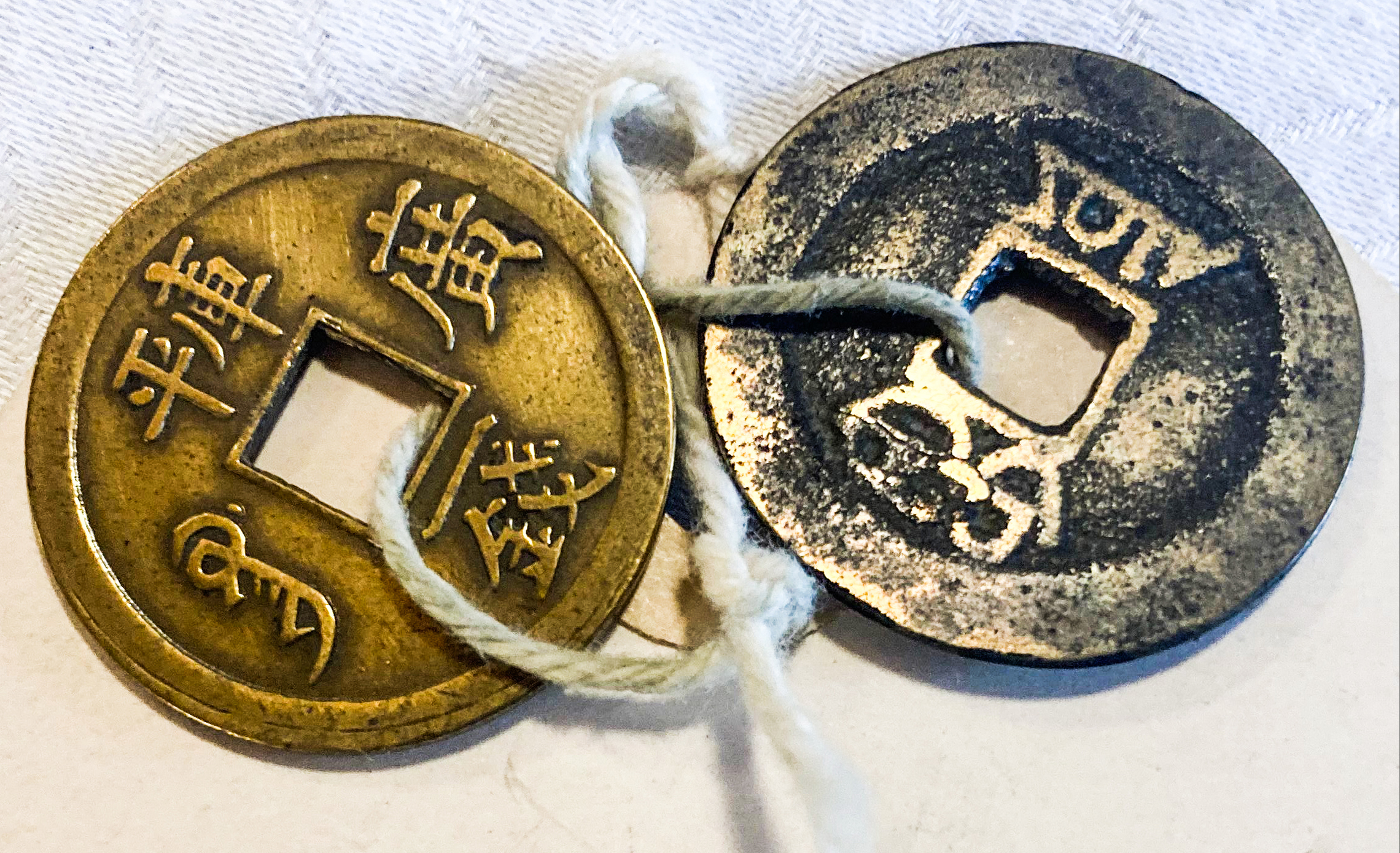
These coins from cabinet #10 are the oldest in our collection. Their exact year is unknown but they contain both Chinese and Mongolian characters. As seen in the picture above these coins contain square holes in their center for the purpose of putting a string through to connect them, making it easier to carry multiple coins at a time.
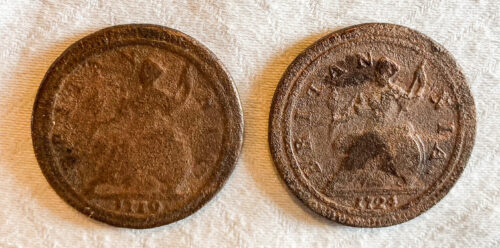
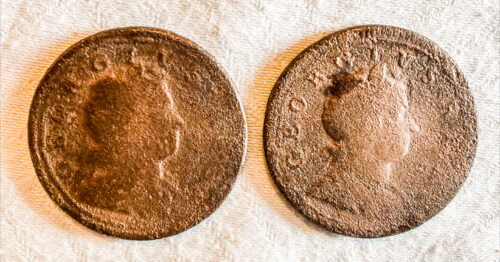
The front and back pictures of these two half pennies are of King George I (r. 1714-1727) of the United Kingdom. The one to the left was minted in 1719 while the one to the right was minted in 1724.
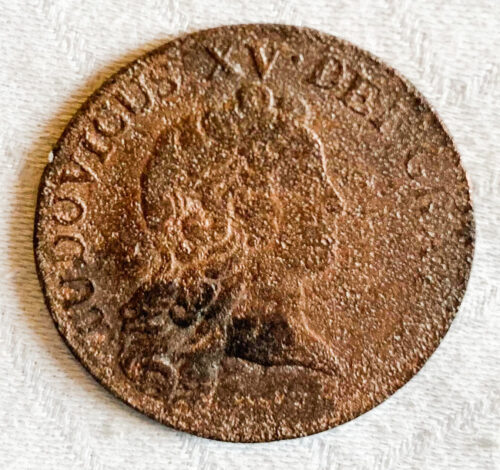
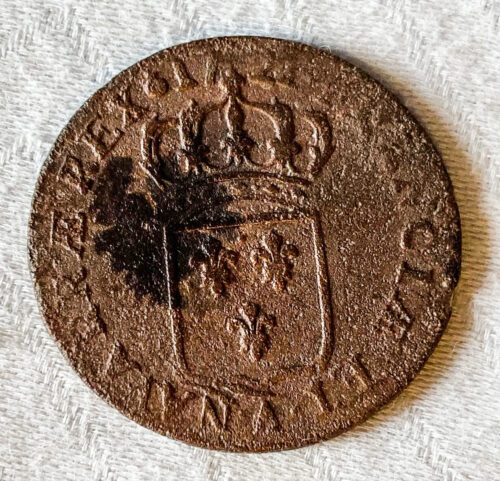
Shown here are the front and back sides of a 1721 half cent Sol depicting King Louis XV (r. 1715-1774 ) of France. In 17th and 18th century France, a denier was the cheapest coin. A Sol (Sous) was worth 12 deniers. A Livre (Franc) was worth 20 Sols. An ECU was worth 3 Livres. A Pistole was worth 10 Livres and a Louis was worth 20 Livres.
Information on 17th and 18th Century French currencies was obtained from “THE VALUE OF FRENCH CURRENCY IN THE 17th & 18th CENTURIES,” https://vtgenlib.org/general/quebecResearchInfo/french_currency.pdf. Which was originally printed in “L’Entraide”; the journal of the Societe Genealogie des Cantons de l’Est. November 1998.
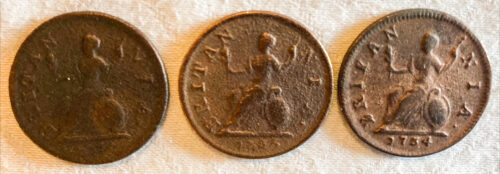
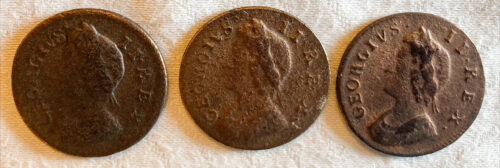
These front and back pictures of three half cent Farthing coins were minted in 1734 and depict King George II (r. 1727-1760) of the United Kingdom.
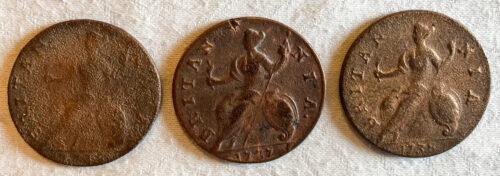
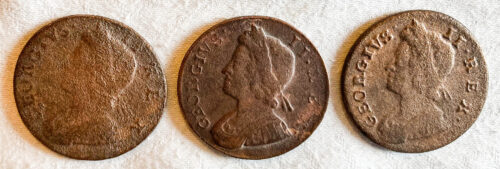
These front and back pictures of half cent coins from depicting King George II were minted (in order from left-right) in 1734, 1737 and 1738.
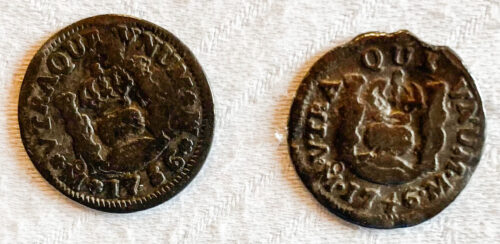
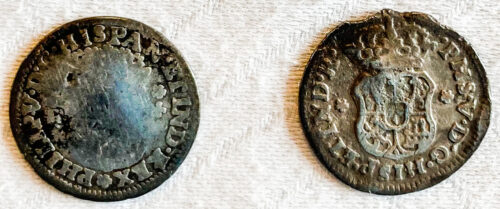
These front and back pictures showcase two half reals from depicting King Philip V (r. 1700-1724; 1724-1746) of Spain. The coin to the left was minted in 1736 and the coin to the right was minted in 1746.
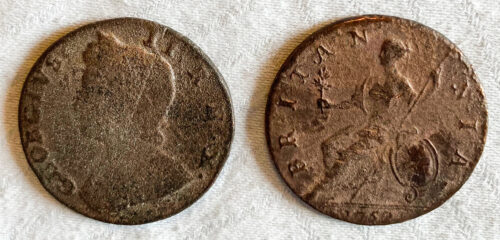
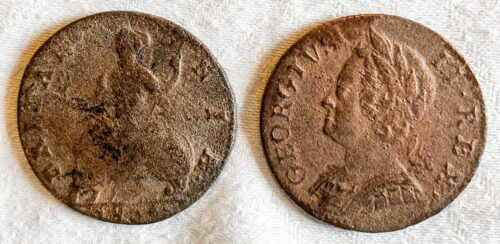
These two half pennies depicting King George II were minted in 1752. A British half penny was worth one cent.
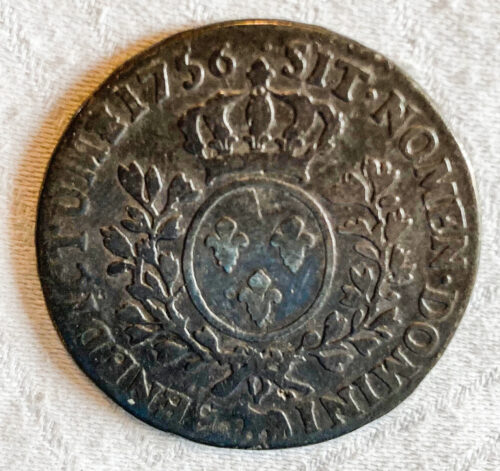

This French Ecu depicts King Louis XV and it was minted in 1756.


This 1781 Hibernia coin depicts King George III.


These are the front and back pictures of a fifty dollar bill from that was used during the American Revolution. This one was printed in 1779 by Hall and Sellers. It was backed up by Spanish silver. David Hall and William Sellers ran Hall & Sellers Press in York County, Pennsylvania which mainly printed newspapers. Hall had originally worked for Benjamin Franklin’s paper, The Gazette in 1743. Hall took over publishing in 1748 and the paper was renamed Franklin & Hall. In 1766, Hall became the sole owner of this press and promoted one of his printers, William Sellers to partner. After Sellers became a full partner the press was renamed to Hall & Sellers. Sellers continued to run the press after Hall’s death in 1772 and expanded to printing paper currency during the American Revolution.
Information on Hall & Sellers obtained from, Laura Klotz, Hall & Sellers Press, York, York County. Marker Quest. January 19, 2022. https://pamarkers.blogspot.com/2022/01/hall-sellers-press-york-york-county.html.


These images depict a three dollar bill that was printed in 1776 by Samuel Loudon. Loudon was a printer from Fishkill, NY who in 1777 printed New York’s Constitution. From 1777 to 1783 he served as the Fishkill Postmaster. At that point, during the Revolutionary War, Fishkill was the only post office in the state.
Information on Samuel Loudon was obtained from, William G. Pomeroy Foundation. Historical Marker: Samuel Loudon. Fishkill Historical Society. Website by The Lab Creative. https://www.wgpfoundation.org/historic-markers/samuel-loudon/.


These images depict a two-thirds of a dollar bill. The front side has an image with 13 rings that depict each of the 13 original colonies. Like the first dollar bill, this one was printed by Hall and Sellers in Philadelphia.


These images depict a ripped three dollar bill printed in 1775 by Hall and Sellers.


This Spanish-American Real depicts King Charles III (r. 1759-1788) of Spain and it was minted in 1783. The US coin became the official currency of the United States in 1785. Spanish silver coins were continuously used as American currency until 1857 when it was banned for offical transactions under the “Coinage Act.” A Real was worth twelve cents.
Information on the Spanish Real obtained from the National Park Service, Spanish Coins. Part of an article from Curious Collections of Fort Stanwix, The Oneida Carry Era. https://www.nps.gov/articles/000/spanish-coins.htm
Other information obtained from,
Hanson, Lee M. Casemates and Cannonballs: Archaeological Investigations at Fort Stanwix, Rome, New York. Washington: National Park Service, 1975.


These Spanish Half Reals each depict King Charles III. The one to the left was minted in 1786 while the one to the right was made in 1805. A Half Real was worth six cents.


This 1787 American Fugio cent was the first coin issued by the U.S. Congress. One side of this coin contains 13 rings which each represent the original 13 colonies (like the two-thirds of a dollar bill shown above). The other side contains a sun dial with the motto “Mind Your Business,” which was popularized by Benjamin Franklin. The copper that was used to strike these coins came from U.S. military supplies, more specifically the copper was from bands to hold powder kegs which were sent by France during the American Revolution.
Information regarding the Fugio Cent was obtained from,
Federal Reserve Bank of Atlanta, Fugio Cent (Franklin Cent). https://www.atlantafed.org/economy-matters/banking-and-finance/clash-of-the-coins/coin-02_franklin-cent.aspx.


These two above pictures showcase immitation 1787 Half Pennies depicting British King George III (r. 1760-1820). These coins likely came from Thomas Machin Mills, NY. Fake currency such as these coins lead to the Copper Panic of 1789.


This is a 1787 New Jersey copper coin that was worth one cent. During the Articles of Confederation (1781-1789) each state had it’s own currency. The United States did not have a uniform currency until the 1792 Coinage Act.
Information obtained from,
“The History of US Circulating Coins,” United States Mint: Connecting America Through Coins. Last Updated October 27, 2023. Accessed June 17, 2024. https://www.usmint.gov/learn/history/us-circulating-coins.


This is a 1793 U.S. which contained the words “One Hundred for a Dollar” engraved on it’s edge. As seen in the left picture, this coin depicts a wreath encircling the words “One Cent.” The initial design of this coin included 15 rings to symbolize the original 13 colonies and the new states of Vermont and Kentucky. This design was criticized for resembling a chain which many felt symbolized slavery and was therefore changed into a wreath.
Information obtained on the wreath obtained from,
“The History of US Circulating Coins,” United States Mint: Connecting America Through Coins. Last Updated October 27, 2023. Accessed June 17, 2024. https://www.usmint.gov/learn/history/us-circulating-coins.


These three U.S. coins are half cents. As its name implies a half cent was worth half of a U.S. penny. The left and center coins were minted in 1804 while the coin to the right was made in 1805.


These four U.S. coins were each worth one cent. These coins are arranged in order from top left to bottom right chronologically spanning the years 1805, 1818, 1845 and 1849.


This 1807 British Half Penny depicts King George III.


This New York coin from around 1835 was a Mercantile Exchange trade token that was locally worth one cent. Inscribed on one side reads “Millions for Defense, Not One Cent for Tribute.”


This one cent U.S. coin which now contains a hole was minted in 1861, the same year that the Civil War began. This coin is from cabinet #10.

Here are six paper dollars from 1862. The top and bottom rows each show dollars equal to 50, 25 and 10 cents. These dollars were used and produced by the Schoharie County Bank. These paper dollars came from cabinet #10.


This U.S. Dime was minted in 1878.


This U.S. Half Dollar coin was minted in 1893. More specifically it was minted during the World’s Columbian Exposition held in Chicago. The exposition was a world fair which lasted from May to October. The US hosted this fair in part to celebrate the 401st anniversary of Christopher Columbus landing in the Americas. This coin is from cabinet #10.


This U.S. Quarter was minted in 1909. The term “In God We Trust” was first used on US currency in 1864 during the Civil War. As of 1908, all US gold and silver dollar coins, half dollars and quarters were required to display this phrase. By 1938 all US coins displayed this phrase. In 1957, at the height of the Cold War this phrase was printed on all US paper currency. This was done to differentiate the United States (which was secular yet largely religious) from the Soviet Union which gradually tried to eliminate religious beliefs.
Andrew Glass, ‘In God We Trust’ becomes the nation’s motto, July 30, 1956. Politico. July 30, 2018. Accessed June 13, 2024. https://www.politico.com/story/2018/07/30/in-god-we-trust-becomes-nations-motto-july-30-1956-741016.


This U.S. cent was cut in half and would have been worth half of a cent. In addition to silver coins commonly being cut, copper coins were often cut into halves, thirds and fourths for the purpose of making change.


This was a British Half Penny that was cut in half. Since Half Pennies were worth one cent, this piece would have been worth half of a cent.


This U.S. cent has been cut into quarters and was worth a quarter of one cent.