This exhibit showcases some of our vast collections of arrowheads and various other stones used for different purposes. Many if not all of these objects were used by Native Americans. The first five photographs in this exhibit come from Cabinet #27. The rest of the photographs are from Cabinet #28.
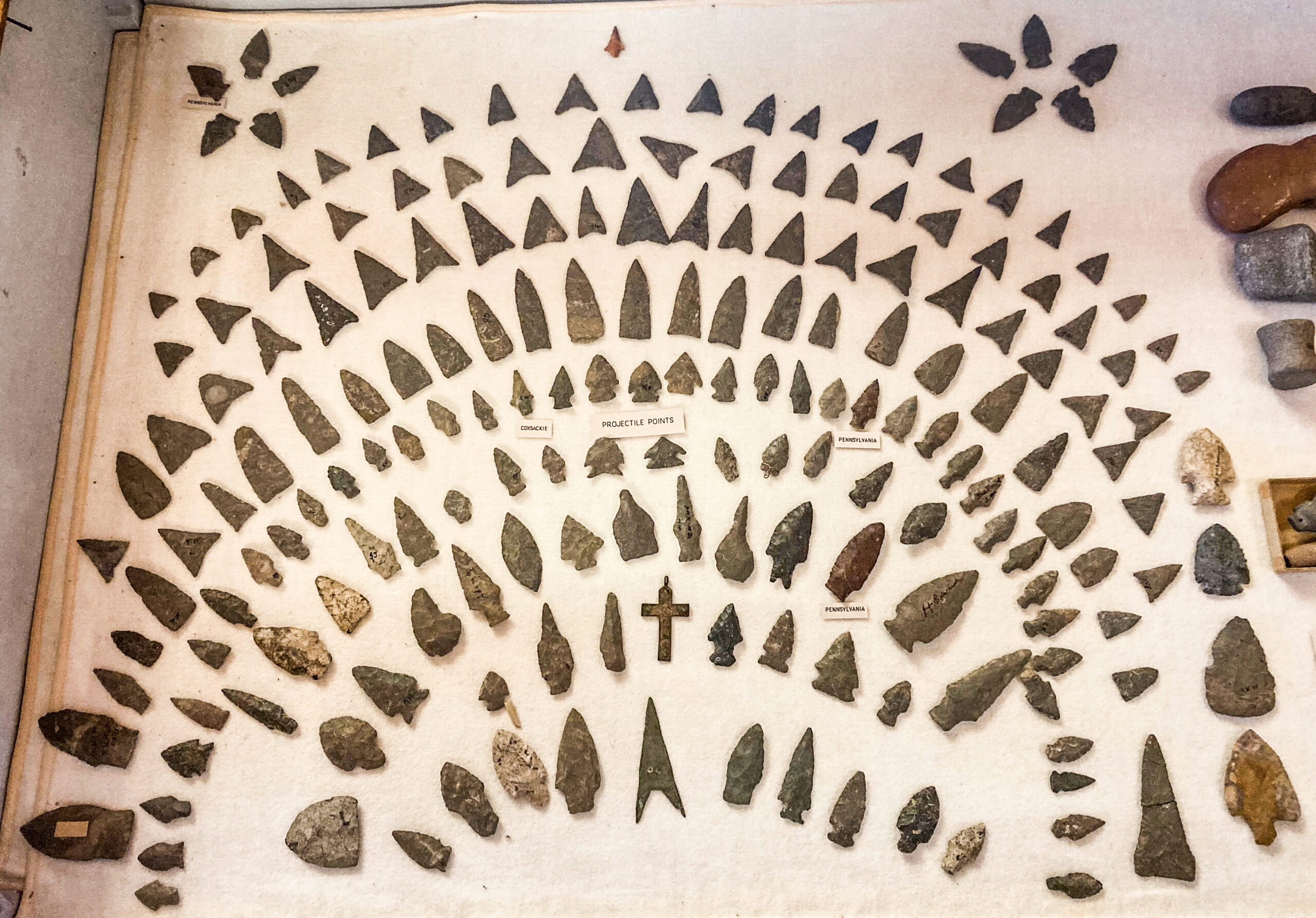
This above photograph shows a collection of arrowheads (projectile points). As shown, some of these arrowheads came from Coxsackie, NY while others came from Pennsylvania. To the bottom center of this set is a metal cross. These were part of the Arthur U. Stevenson collection.
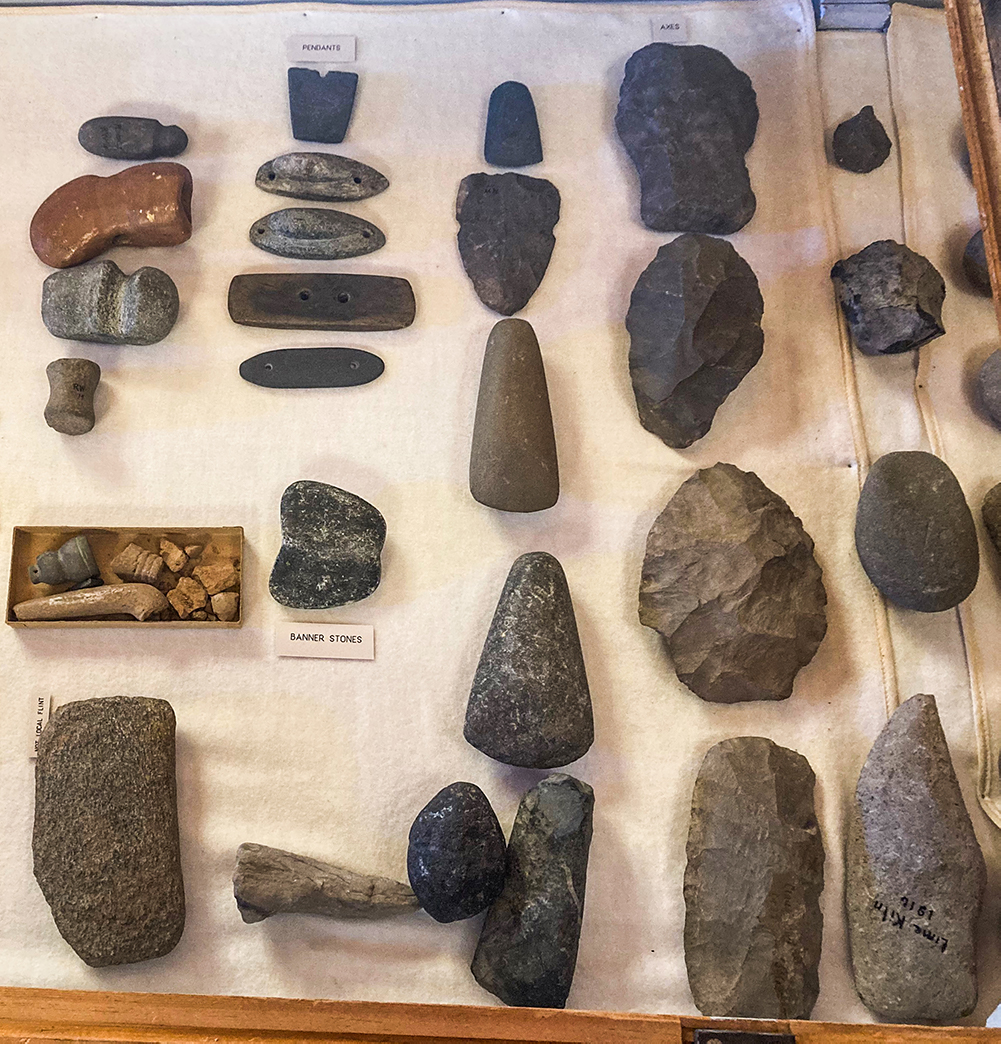
This above picture showcases in order of left to right flint, pendants, banner stones and axe heads. Banner Stones were often symmetrical in shape and holes were chiseled into them. These stones were often placed on the shafts of atlatls to add extra weight. Atlatls were in some ways the precursor to bows. An atlatl would also allow someone to throw a spear much further than they could by just using their arm.
Information on Banner Stones was obtained from,
Dr. Anna Blume, “Bannerstones, North America” in Smarthistory, June 3, 2021. accessed December 3, 2024, https://smarthistory.org/bannerstones-north-america/
As for the pendants and gorgets in this picture, the ones with only one hole are considered pendants, the ones with two holes are called gorgets. Both pendants and gorgets were warn around the neck. Gorgets get their name from the word “gorge” which means throat as they were warn on a necklace around the throat. Yet some Native Americans, like some from the Miami Tribe were seen wearing these in their hair.
Information on pendants and gorgets was obtained from,
James Tharpe, “Gorgets and Pendants, Stone Ornaments.” BannerStones, Plainfield, Indiana, accessed December 3, 2024. https://bannerstones.com/gorgets-and-pendants-stone-ornaments/
To the far right of this picture are stone axe heads. It is likely that these were early hand axes that were tied to a wooden handle with sinew. Later axe heads contained holes which allowed its handle to fit better.
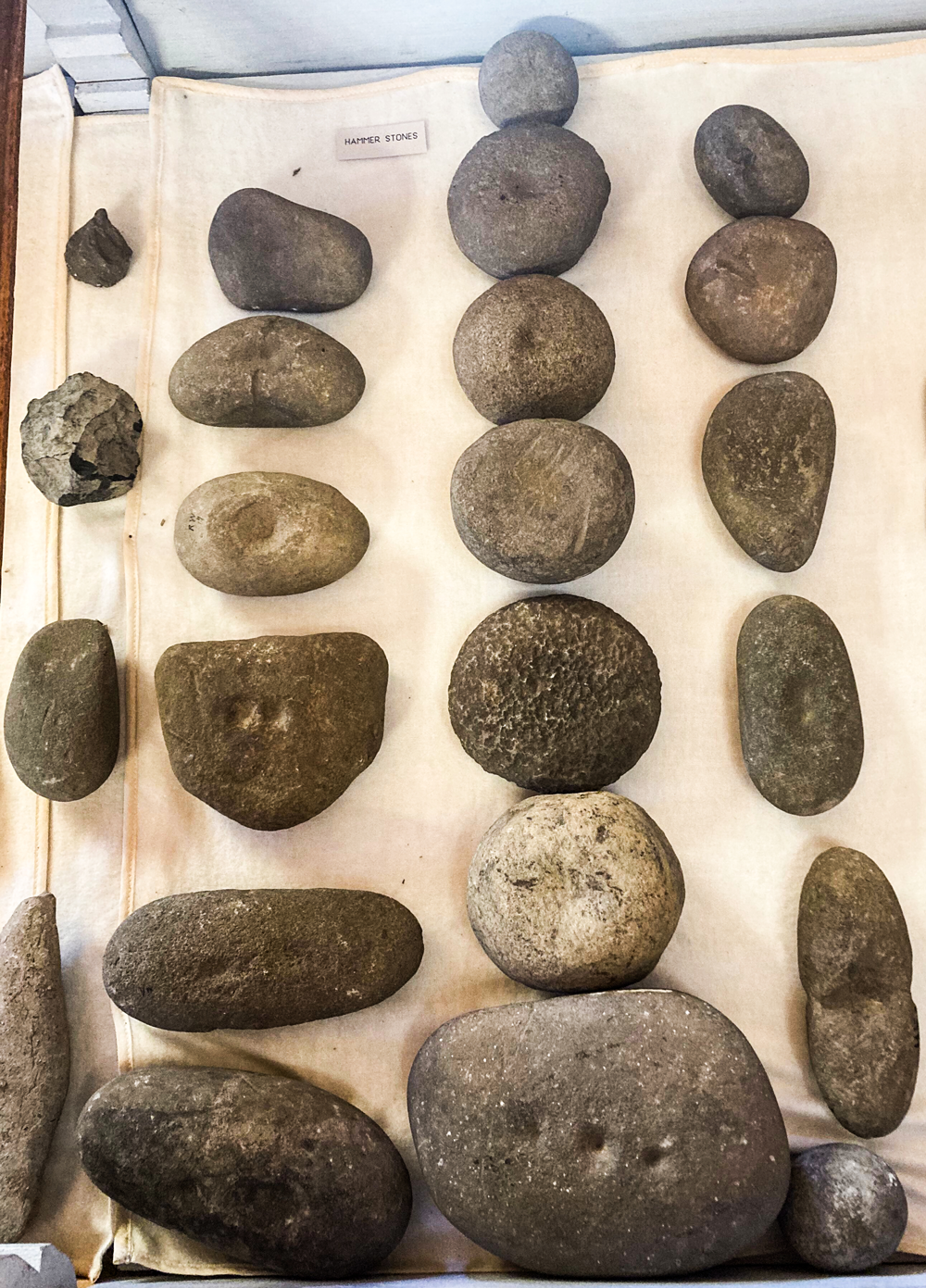
The above picture displays hammer stones which as their name implies were used as hammers. It is likely that some of these stones (which had small holes through them) were placed on top of a fire starting bow to hold it steady.
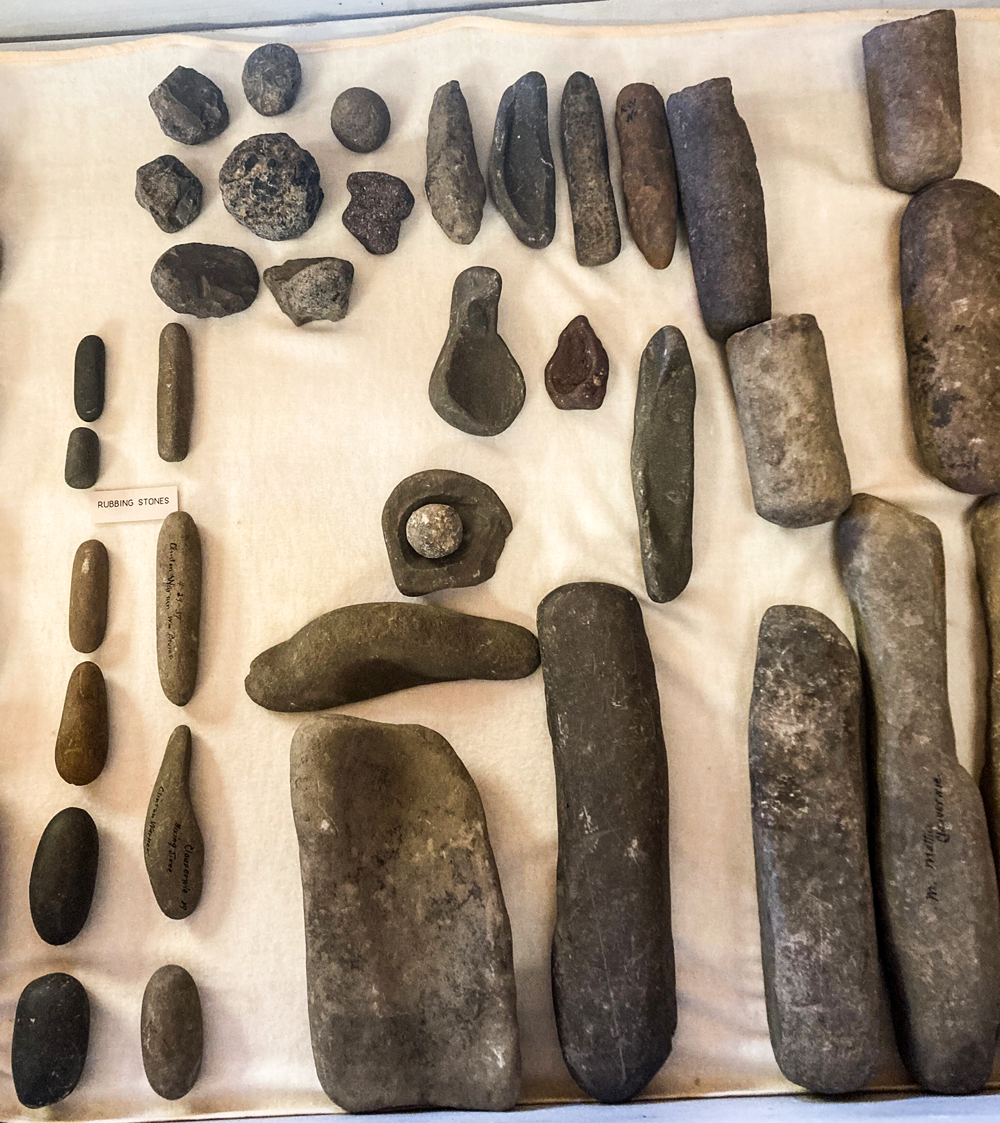
The small narrow oval shaped stones to the left are rubbing stones. Rubbing Stones, which are now more commonly referred to as “Worry Stones” were held and rubbed between the fingers as way to calm oneself. These stones were also used for meditation and to increase focus.
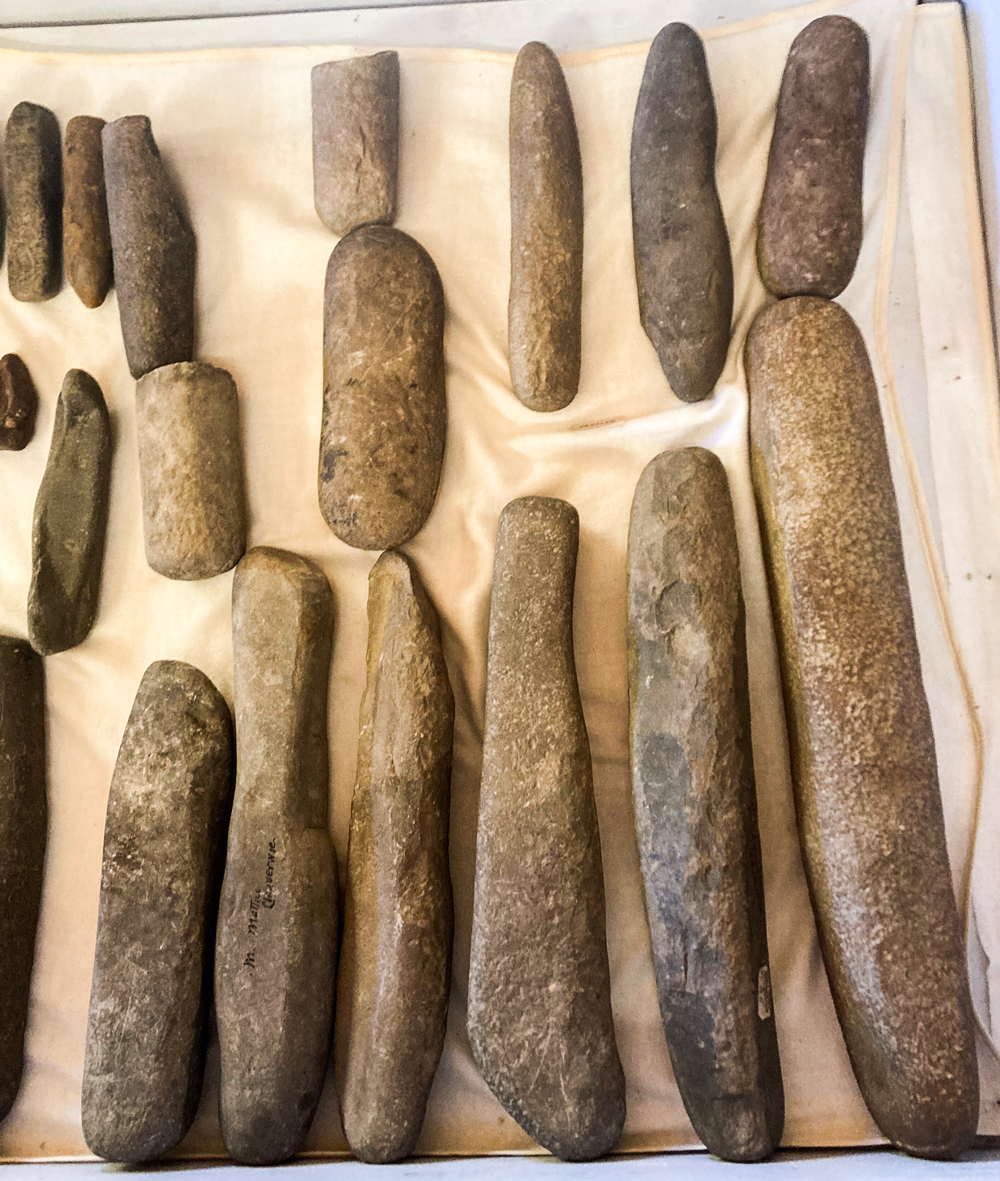
We have now reached the other side of Cabinet #27. This above picture showcases long narrow stones. These stones were most likely used as pestles to ground up food and spices in mortars. It is also possible that these long stones were used as rolling pins.
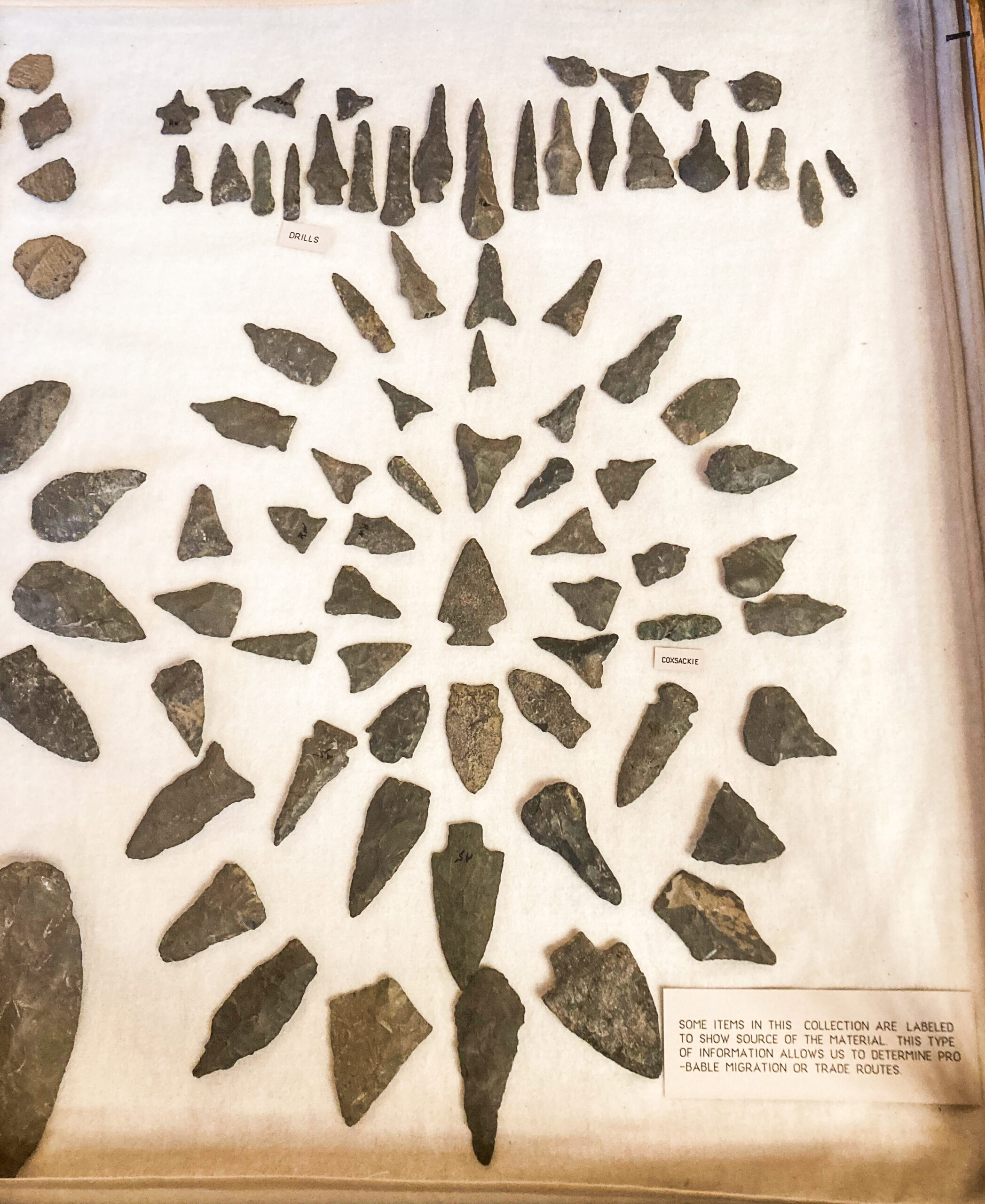
This picture from the right side of Cabinet #28 showcases a collection of drills and projectile points. Many of these appear to have once been arrows but a few of them probably came from spears. The drills showcased in this picture likely would have been used to drill holes into wood and stone. This collection was found by former Schoharie County Historian Arthur U. Stevenson of Middleburgh. Almost all of these artifacts were found in the Schoharie Valley.
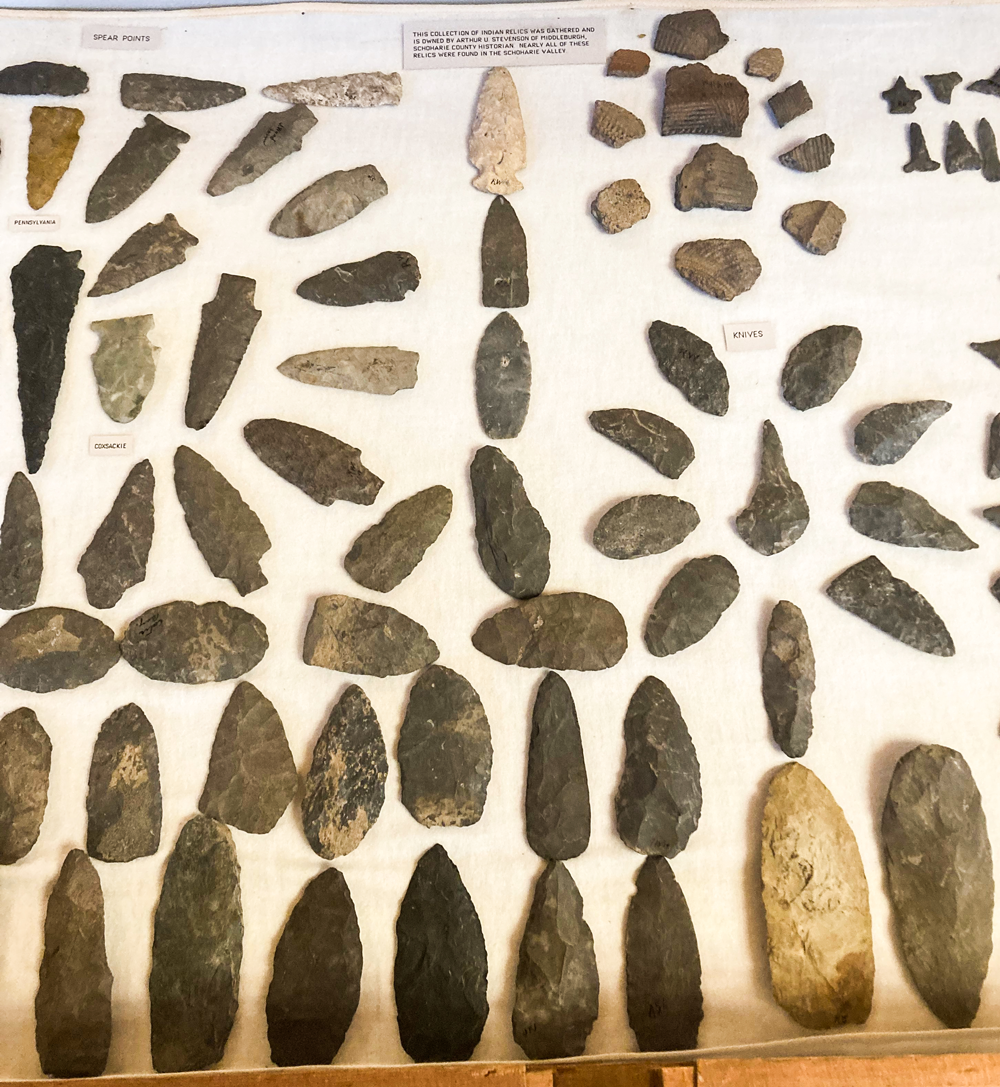
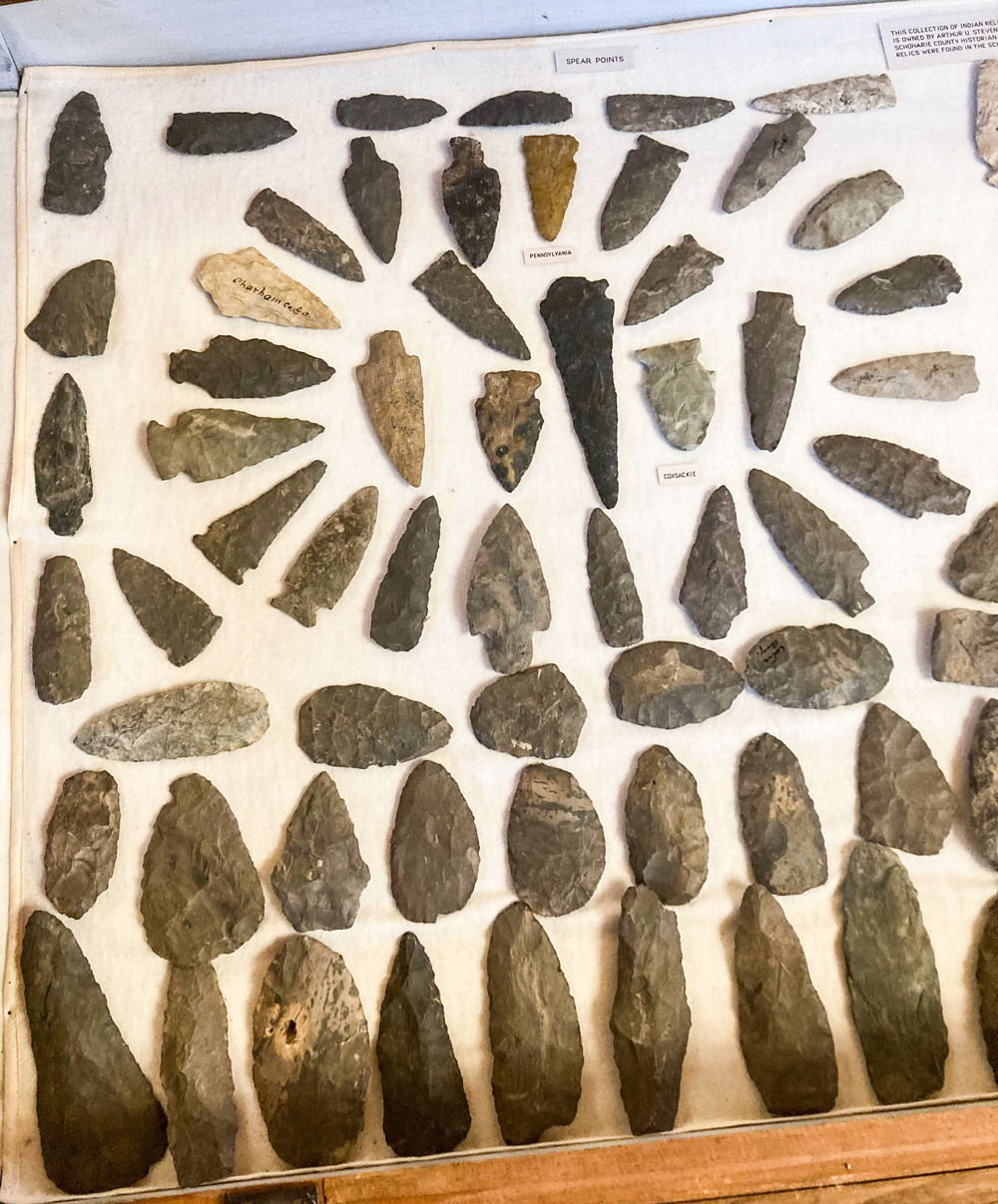
These above pictures showcase various stone knives and spear points.
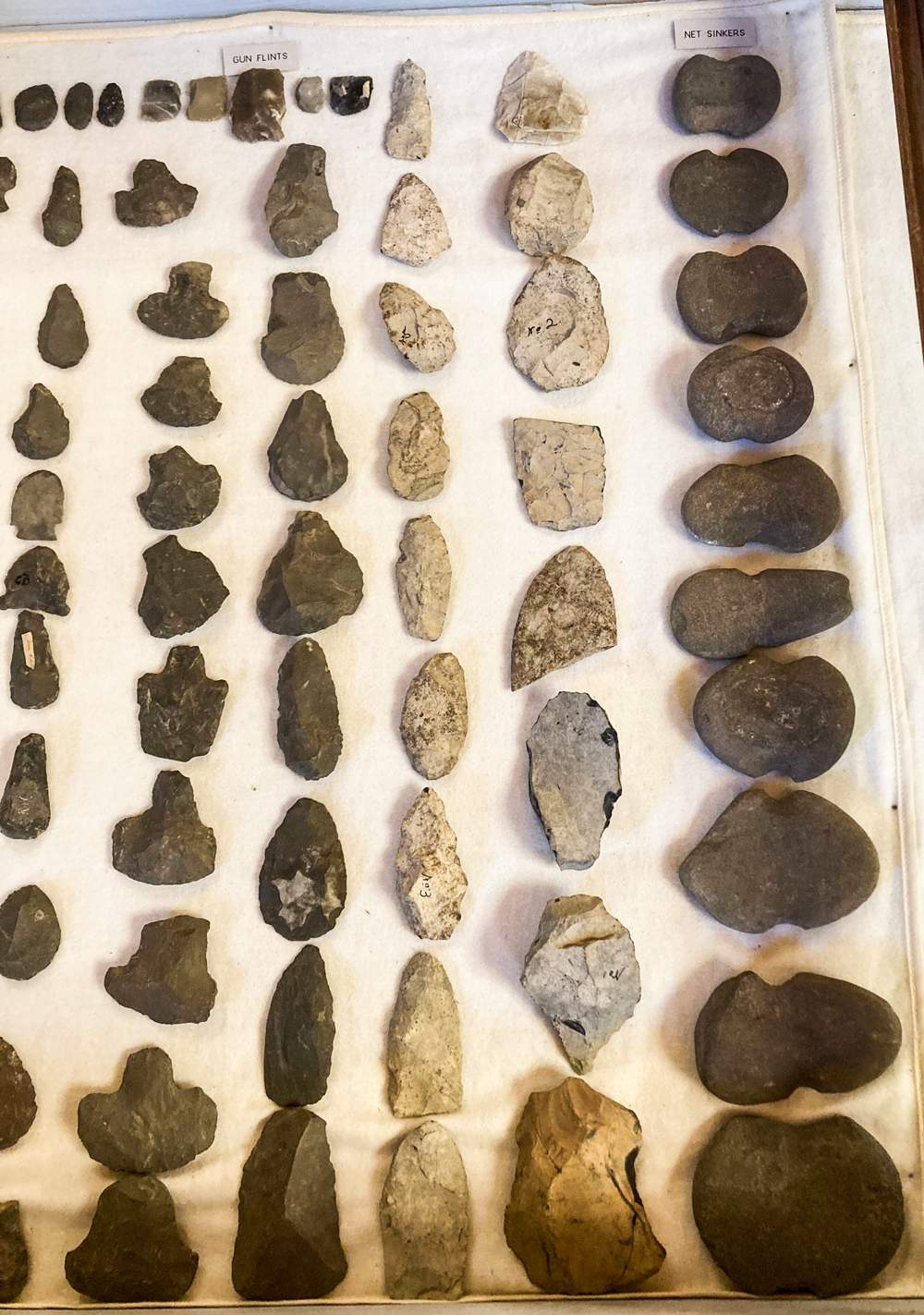
Here we see a collection of net sinkers and gun flints. Net sinkers were used to help sink fishing nets into the water. Stones such as these were tied to the bottom of these fishing nets which made it easier to keep said fish from escaping captivity. Although these stones were most likely found around here, net sinkers were used for thousands of years. These stones have notches in them that allow for the rope to be tied around them. Multiple notched stones would be tied to these nets to hold them down. In 2018 there was an article which reported on the finding of limestones in a South Korean cave which led archaeologists to speculate that humans have used net sinking stones for as long as 29,000 years.
Information on notched net sinking stones was obtained from,
Larry Porter, “Notched Stone Net Sinkers.” University of Arkansas System: Arkansas Archeological Survey. WRI Station Artifact of the Month – November 2020. Accessed December 10, 2024. https://archeology.uark.edu/artifacts/netsinkers/
Information on net sinking stones from South Korea was obtained from,
“Cast from the past: World’s oldest fishing net sinkers found in South Korea.” Phys.org. August 7, 2018. Accessed December 10, 2024. https://phys.org/news/2018-08-world-oldest-fishing-net-sinkers.html
Gun flints were a crucial component to the flintlock musket which was first introduced in the 16th century. These small pieces of flint were held in place by a clamp and struck by the gun cock once the trigger was pulled, creating a small explosion inside the barrel which allowed the gun to fire the musket ball. With flintlocks, the pan of the gun would have to be primed with a little black powder before the muzzle was loaded with a paper cartridge consisting of the musket ball at its bottom with black powder in front of it. Gun flints made it easier to keep the black powder dry and allowed for more efficient firing.
Information on Gun flints was obtained from,
“Gun Flint: Park Authority.” Fairfax County, Virginia. Accessed December 10, 2024. https://www.fairfaxcounty.gov/parks/artifacts/gun-flint#:~:text=First%20introduced%20in%20the%2016th,used%20to%20create%20stone%20tools.
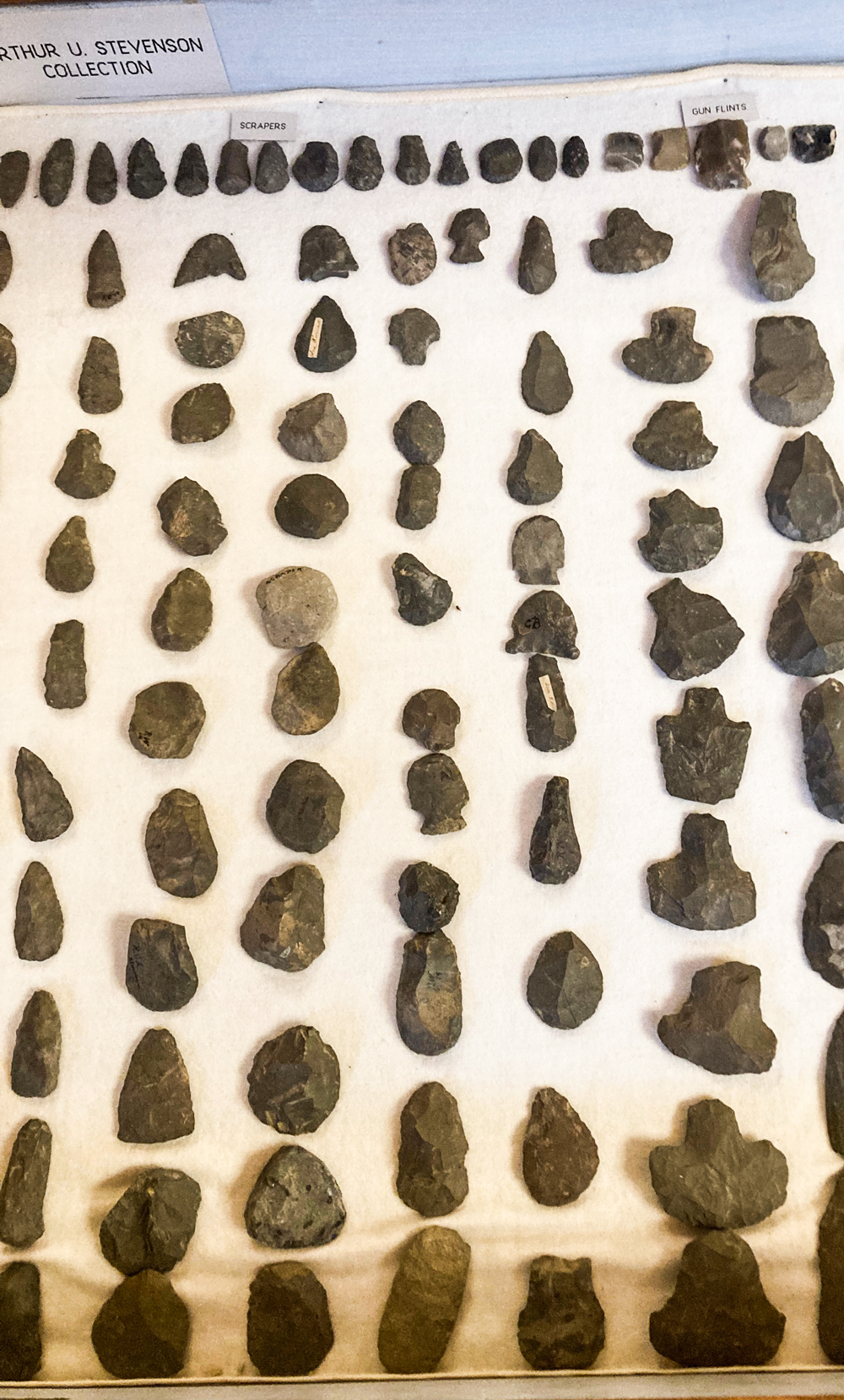
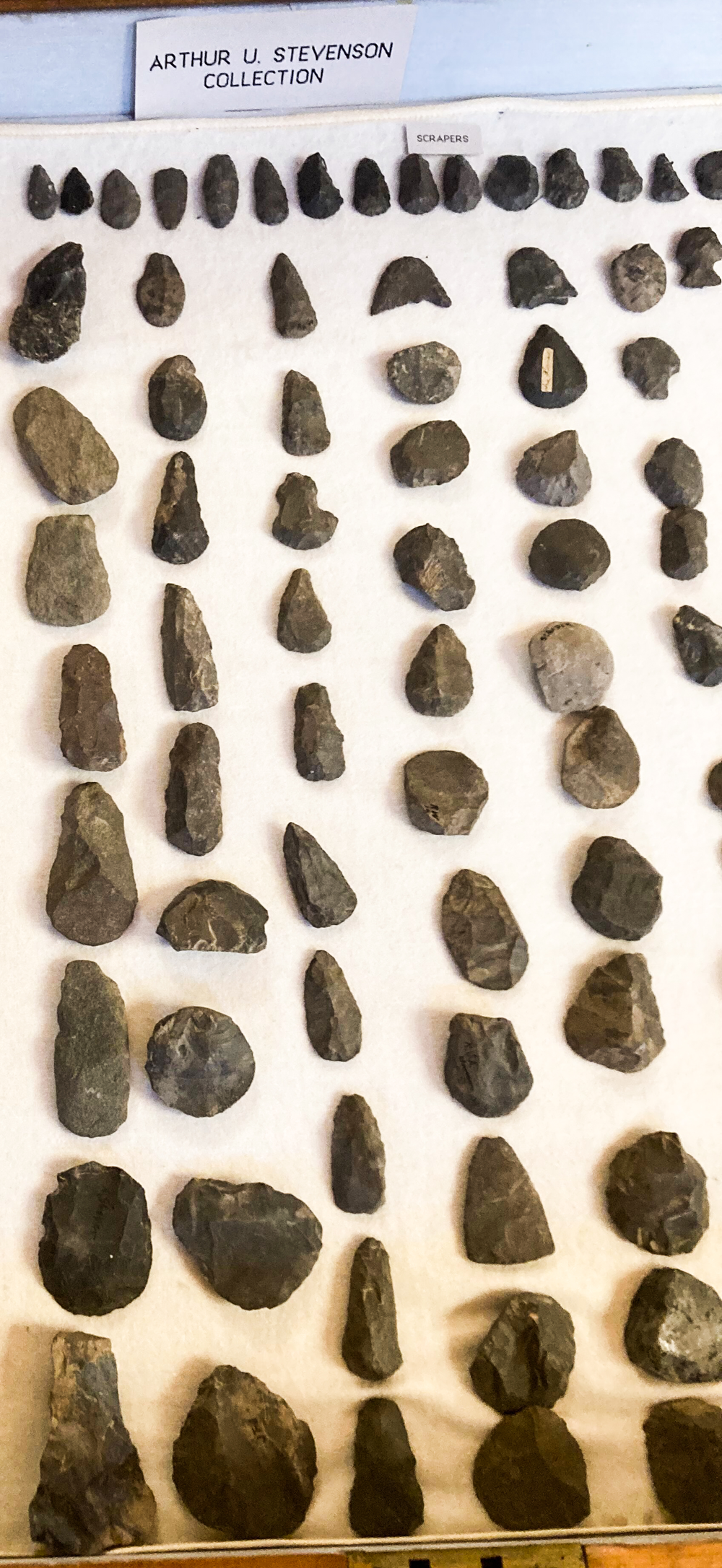
These above pictures showcase scraper stones. Scraper stones were commonly used to skin animals, cut meat and scrape bark off from trees to make spear handles. These stones were said to be used by people during the early holocene which began around 11,700 years ago and is the current era in which we are living.
Information on scraper stones was obtained from,
“Artifact of the Week: Stone Scraper.” San Diego Archaeological Center. Accessed December 10, 2024. https://sandiegoarchaeology.org/artifact-of-the-week-stone-scraper/
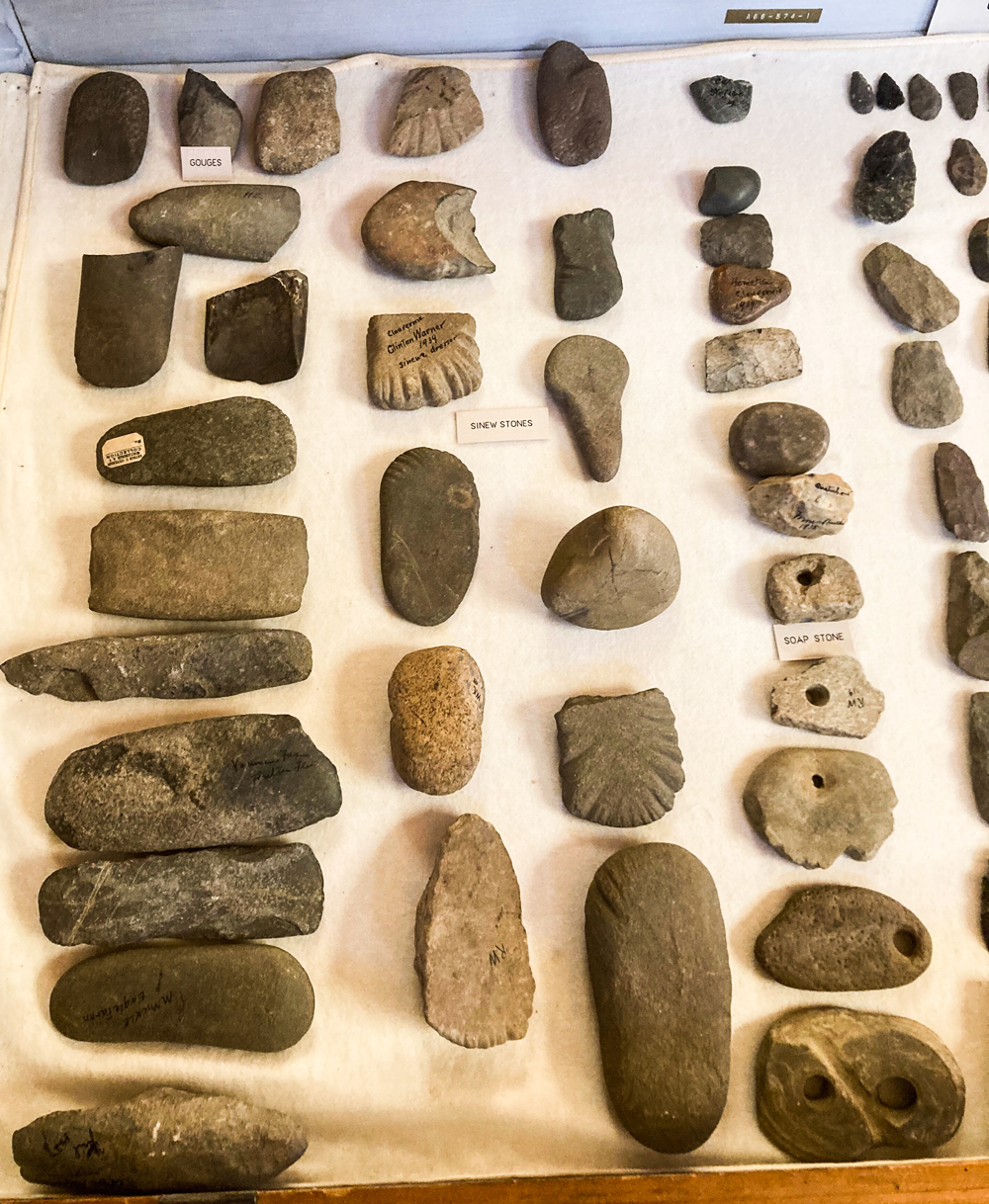
Contained within this picture are several pieces of soap stone, sinew stones and gouges. Soap stone earned its name due to its smooth soap-like texture. It is a metamorphic rock and therefore heat-resistant which makes it ideal for casting metals such as lead, silver and pewter. It has also been used to make items such as cooking pots, fireplaces, pizza stones and tobacco pipes. It is easy to cut compared to other stones and is commonly used to make kitchen counters, sinks or even shower walls.
Information of soap stone was obtained from,
Raphaiane Silva and Kevin Cole, “A Deeper Look at Soapstone.” International Surface Fabricators Association. Accessed December 10, 2024. https://www.isfanow.org/a-deeper-look-at-soapstone#:~:text=As%20a%20metamorphic%20rock%2C%20it,stoves%2C%20and%20even%20tobacco%20pipes.
Sinew stones were commonly used by Native Americans to rub strips of sinew from animals to soften it enough to turn into strings for bows. Alternatively these strings were also used for tying or lashing objects.
Information on Sinew stones was obtained from Digital Collection-Notched Abrading Stone (Sinew Stone). Accessed December 10, 2024. http://americancenturies.mass.edu/collection/itempage.jsp?itemid=5234#:~:text=Native%20Americans%20used%20this%20stone,3000%2D500%20years%20ago).
Stone gouges were commonly used for chiseling out charcoal and making wooden bowls. Larger stone gouges were used to make dugout canoes.
Information on gouges was obtained from,
“Artifact – Stone gouge,” Accessed December 10, 2024. http://1704.deerfield.history.museum/popups/artifacts.do?shortName=stone_gouge