History of the Oliver Schoolhouse
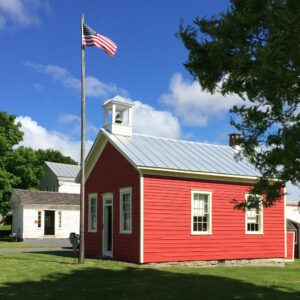
Originally located halfway between Summit and Charlotteville in an area known as Clam Hollow, the Oliver Schoolhouse served as a one-room schoolhouse in Summit School District No. 3 for approximately 80 years. It was built in 1863 to replace the district’s first schoolhouse, constructed in 1821 and later destroyed by fire.
In 1880, Schoharie County had 207 schools, providing the only formal education many rural residents would ever receive. Before motorized transportation became widespread, schoolhouses were typically built near the center of each district so children could walk to class, often traveling a mile or two from home.
For more than 150 years, the Oliver family lived on a nearby farmstead, and several generations of Oliver children attended school here. The schoolhouse represents an important part of Schoharie County’s educational heritage, offering a glimpse into rural school life as it was experienced between 1890 and 1914.
From Rural Schoolhouse to Museum
New York State began considering the consolidation of rural schools as early as 1905. The Oliver Schoolhouse continued to operate until 1942, when it officially closed with only three students in attendance.
In 1963, Dr. Ward Oliver and Dr. Virginia Oliver purchased the schoolhouse and its grounds with the intention of preserving the building as a rural school museum. Over the years, the building was repeatedly broken into, and many items were stolen, including the school bell, most of the furniture, books, and maps.
The Olivers eventually donated the building to the Schoharie County Historical Society. In 1984, the schoolhouse was moved to the Old Stone Fort Museum Complex, where it was restored and named in honor of the Oliver family. Ward Oliver, a former student and teacher at the school, played an important role in preserving this piece of local history.
The land where the schoolhouse originally stood was donated to the Town of Summit for use as a public park.
Experience Rural School Life
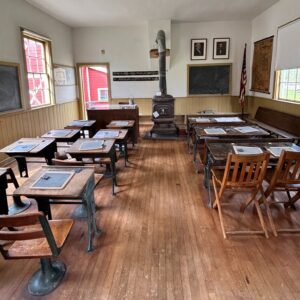
Today, the Oliver Schoolhouse has been carefully restored and furnished with original artifacts and historically accurate reproductions to reflect rural education in Schoharie County between 1890 and 1914.
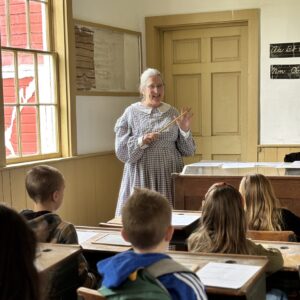
Visitors can step back in time to experience a typical one-room classroom of the late 19th and early 20th centuries. Children are encouraged to sit at the desks and explore sample lesson materials, making the visit both educational and memorable. The classroom also offers wonderful photo opportunities.
Behind the schoolhouse stands one of its two original outhouses, known at the time as the “necessary.”
Through its restored classroom, period furnishings, and educational materials, the Oliver Schoolhouse preserves an important chapter in local history and offers visitors a glimpse into the daily lives of rural schoolchildren and teachers more than a century ago.
A Day at the Oliver Schoolhouse
The school day began at 9 a.m. with the ringing of the bell. The bell also signaled the noon lunch break, allowing nearby fieldworkers to keep track of the time. Students enjoyed a 15-minute recess during both the morning and afternoon sessions. School typically ended at 4 p.m. on weekdays and at noon on Saturdays. There was little or no homework.
Eight grades were taught in the same classroom, with pupils seated according to grade level. The youngest children sat closest to the teacher. Discipline was strict, and students were permitted to talk only during recess. Despite these rules, the classroom could be quite noisy, as reciting memorized lessons aloud was an important part of the school day.
Lessons and Classroom Activities
Students usually recited poetry and presented reports from a large bench along the front right-hand wall. With several lessons taking place simultaneously, students had to concentrate on their own work while listening to the instruction given to others. Some former students later recalled that this arrangement was beneficial, allowing them to hear the lessons of older pupils repeatedly and gain an early understanding of more advanced material.
Individual slates and slate pencils were used for repetitive exercises, creating a considerable amount of clatter. Older students made greater use of paper, pencils, and pen and ink. Their desks contained individual inkwells, and children brought pencil boxes to hold their writing and drawing tools, which might include a ruler, compass, protractor, and knife or pencil sharpener.
Rules and Discipline
Strict rules governed classroom behavior, with discipline and good manners emphasized throughout the school day. Students were expected to stand when addressing the teacher and could be sent to stand in a corner or required to remain after school for misbehavior.
Teachers were permitted to strike students as punishment, although the practice varied from one teacher to another. Stories of rulers rapping knuckles, switching, and ear twisting may exaggerate how commonly such punishments were used, as memories of particularly strict teachers often became the stories most frequently retold.
Daily Responsibilities
During cold weather, one of the older boys arrived early to build a fire in the woodstove. In some cases, school taxes were paid in firewood. Students were also assigned to carry water for drinking and handwashing from the nearby Oliver Homestead. These responsibilities were often given to pupils based on their academic performance and good behavior.
Students brought their own lunches each day, packed in a pail or wrapped in a handkerchief. Typical lunches included sandwiches, hard-boiled eggs, cheese, and sausage, along with treats such as cookies or slices of bread and cold pancakes topped with molasses, jam, lard, or sugar. Fresh or dried fruit might round out the meal.
The Life of a Rural Teacher
Most teachers in one-room rural schools were young, unmarried men and women. Wages were low, averaging one to two dollars per day for a nine-month term. However, room and board in the district were often included as part of their compensation. Many teachers at the Oliver Schoolhouse stayed with the nearby Oliver family.
New York State’s Changing School Laws
New York State passed its first compulsory school attendance law in 1874, requiring children between the ages of 8 and 14 to attend school for at least 14 weeks each year. In 1894, the law was amended to extend the required school attendance age to 16. The school year generally ran from October through June.
Flags in the Classroom
A law passed in 1895 required every school district to provide each schoolhouse with a United States flag, a flagstaff, and the necessary equipment for displaying it. The reproduction 45-star flag outside the schoolhouse dates to 1896, while the 48-star flag inside was adopted in 1912.
Curriculum and the Country Child
In 1912, New York State’s curriculum requirements for teacher certification and student evaluation included arithmetic, current topics, orthography (spelling), American history, elementary drawing, penmanship, civil government, geography, physiology and hygiene, composition, grammar, and reading.
The curriculum also included special considerations for the “welfare of the country child.” Subjects and activities considered beneficial to rural children’s daily lives included physical well-being and personal appearance, exposure to books and poetry, nature study, agriculture, and field trips.
Changes in Attendance Requirements
In 1903, a provision was introduced for older boys employed in cities, but it did not extend the same consideration to rural schoolboys. In 1909, the law established age 7 as the starting age for compulsory schooling. In 1913, the school year was changed to begin in September.
These changing laws reflected New York State’s evolving approach to education and the growing emphasis on providing children with more consistent schooling.
Preserving a Piece of Local History
The Oliver Schoolhouse offers more than a look inside an old classroom. Its history reflects the experiences of generations of rural children, the dedication of local teachers, and the changing role of education in Schoharie County.
Through the efforts of Dr. Ward Oliver, Dr. Virginia Oliver, and the Schoharie County Historical Society, this historic building has been preserved for future generations. Today, visitors can explore the classroom, learn about the routines and expectations of rural school life, and gain a deeper appreciation for the educational traditions that shaped the community.
The Oliver Schoolhouse stands as a lasting reminder of a time when a small, one-room building served as the center of learning for an entire rural school district.