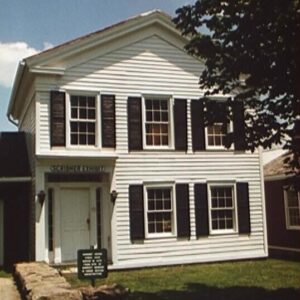
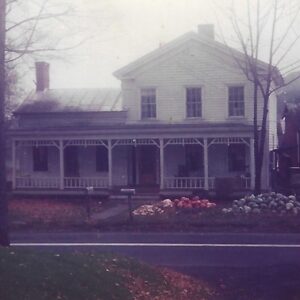
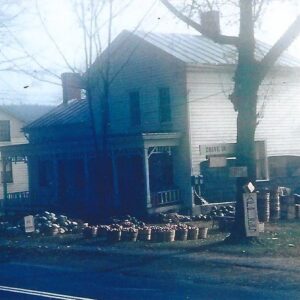
This classic Greek Revival–style house was originally located on the site where the Badgley Annex now stands. The Warner House was moved in the early 1970’s to its present location. The original foundation stones were later repurposed and incorporated into the stone wall along the street in front of the Fort. Today, the structure houses the Scribner Exhibit of 20th-Century Communication Technology. The attached carriage shed is a later addition, not part of the original structure, and is currently used for storage.
The Scribner Exhibit
Local Ingenuity. Big Ideas. Lasting Impact.
A Schoharie County original who turned sound into a powerful tool for innovation.
Innovation on the Home Front
During World War II, Edward M. Scribner put his technical talents to work at a military training post in Sioux Falls, South Dakota. As the post’s sound engineer, Ed designed an innovative Post Broadcasting System (PBS) that kept thousands of daily activities running on schedule.
Sixty bugle calls were broadcast across the base each day, signaling troops when it was time for classes, meals, and physical training. The result was impressive: time spent in classes was reduced by 20%, simply because troops were getting where they needed to be on time!
But Ed didn’t stop there. Recognizing that long hours of code training could be exhausting, he introduced audio breaks featuring music and news during four-hour learning sessions. The improvement was remarkable: troops’ code-learning speed increased by 15%.
He also brought entertainment to the base hospital and movie theaters by installing sound systems, and extended broadcasting beyond the base to benefit the people of Sioux Falls.
Bringing Sound Home
When Ed returned to Schoharie County, he continued putting his creativity and expertise to work.
His broadcasting system at the Cobleskill Fairgrounds was such a success that he went on to design, install, and consult on sound systems for county fairs throughout the region. Schools and churches in Schoharie and neighboring communities also benefited from his work.
Among Ed’s many accomplishments was serving as the projectionist for the Schoharie free street movies shown weekly on Main Street until 1942. He converted the silent projectors to sound when “talkies” were introduced in 1931, what was billed as the world’s first outdoor talking movie. Ed used an Astatic Tru-Tan pickup for the turntable providing music for the Street movies.
Even into his nineties, Ed continued to upgrade the public address systems across the museum site and fairgrounds in the region into the 21st century.